
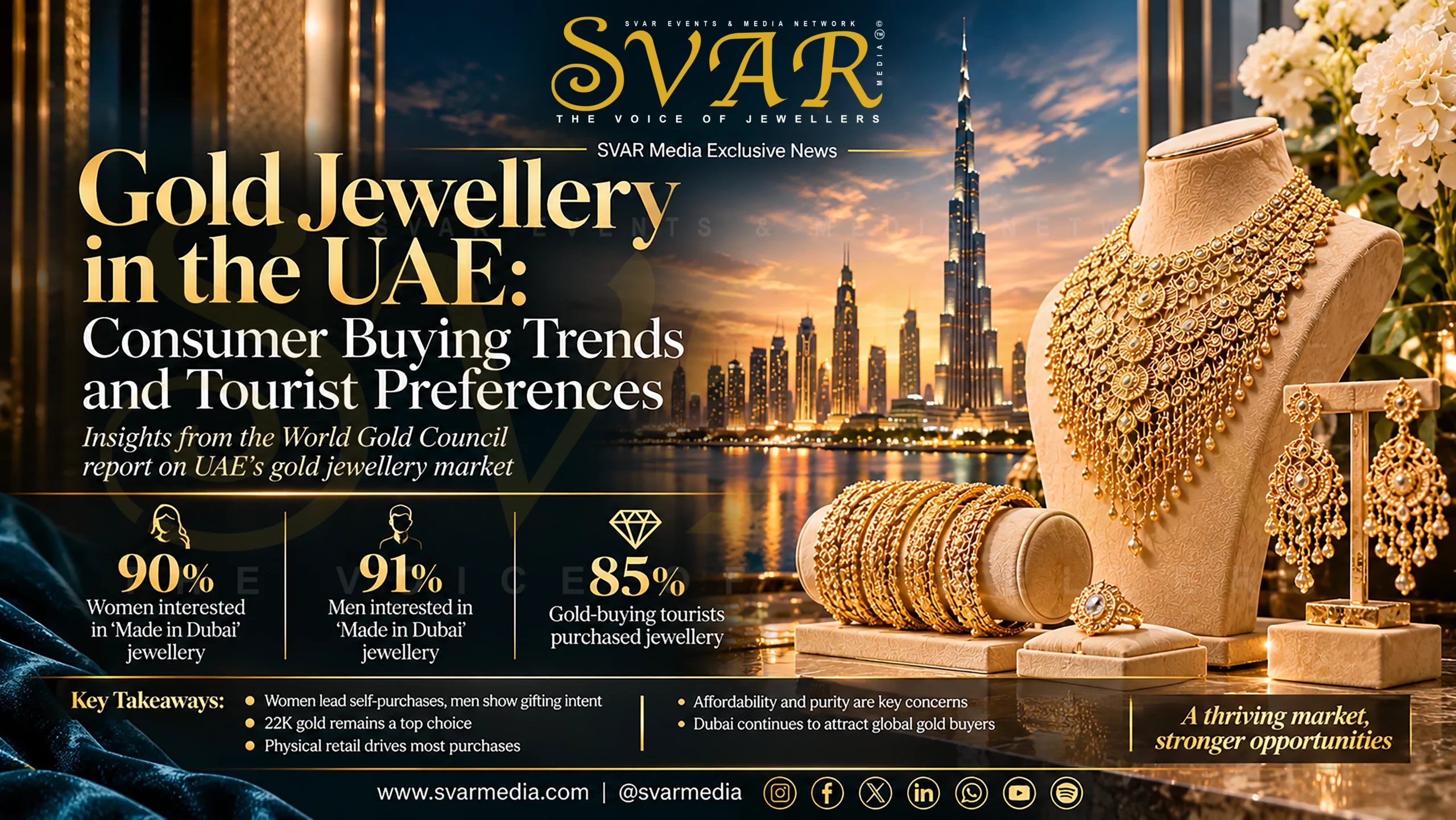
SVAR Media Network presents key insights from the World Gold Council’s latest research on the UAE gold jewellery market, exploring changing consumer preferences, women’s growing self-purchase behaviour, men’s gifting trends, gold purity choices, affordability concerns and the strong appeal of “Made in Dubai” jewellery. The study also examines gold-buying tourists in Dubai, revealing that 85% purchased gold jewellery, with quality, unique designs and VAT refunds among the key purchase drivers. The findings highlight how authenticity, purity, contemporary designs and transparent pricing continue to shape gold jewellery preferences among UAE residents and international visitors.
Quick Summary
- The World Gold Council studied gold jewellery purchasing behaviour among UAE residents and tourists who bought gold during visits to Dubai.
- The residents’ study covered 3,000 people across Dubai, Sharjah and Abu Dhabi, including 1,800 women and 1,200 men.
- 54% of women had purchased fine gold jewellery for themselves, compared with 35% who had purchased it as a gift.
- Among men, 43% had purchased fine gold jewellery for themselves and 41% as a gift.
- Self-reward was the leading motivation for women’s fine gold jewellery purchases, accounting for 42%.
- Wedding anniversaries (34%) and birthdays (27%) were the leading occasions for men’s gold jewellery gifting.
- 22-karat gold was the leading purity preference among women buying for themselves and men purchasing gifts.
- Around seven in ten residents purchased gold jewellery in physical stores rather than online.
- Affordability, additional making charges and concerns about purity were among the leading barriers to purchase.
- Interest in Made in Dubai jewellery reached 90% among women and 91% among men.
- Lighter, contemporary 24-karat gold jewellery emerged as the most appealing product proposition.
- Among surveyed gold-buying tourists, 85% purchased gold jewellery, while 65% cited quality as their leading reason for buying gold in Dubai.
The UAE Gold Jewellery Consumer
The UAE is one of the world’s most established gold jewellery markets. Its strength is underpinned by a diverse, affluent and digitally engaged population and a retail environment anchored by Dubai.
This report draws on consumer research commissioned by the World Gold Council to understand how residents relate to gold jewellery, and complements it with a parallel study of tourists who bought gold during a visit to Dubai. Its purpose is to help industry participants understand these consumers and, where the evidence supports it, identify practical opportunities to broaden the market and reduce barriers that hold back purchases.
The UAE is a dynamic consumer market with a strong appetite for premium and luxury lifestyle products, and gold jewellery sits firmly within this landscape.
Among women, fine gold jewellery is one of the most widely owned lifestyle products, second only to premium technology. Among men, premium technology is also the most widely owned category, with two in five owning fine gold jewellery (41%).
Ownership is not evenly spread. Among women, fine gold jewellery ownership is strongest among those in the Gen X and Boomer group (64%) and Millennials (57%). It is notably lower among Gen Z consumers (46%), who show a relatively greater affinity for premium beauty (47%) and technology (55%).
A broadly similar age pattern is seen among men. By nationality, Expat Asian consumers stand out as a particularly important segment for fine gold jewellery across both genders, while ownership also skews towards more affluent consumers. These differences matter because they indicate where engagement with the category is currently deepest.
Attitudes to gold jewellery are consistent and durable. Among women who have bought fine gold jewellery, around 86% agree that it is an investment, a similar share agree that it can be passed on to future generations, and around 84% that it has good resale value, while 79% see it as something that can be worn on a daily basis.
Among men who have bought it, the same investment (80%), inheritance (77%) and resale (81%) associations come through strongly.
At the same time, both men and women acknowledge that good-quality jewellery is expensive. Among women, around three-quarters agree it is too expensive, a tension that sits behind several of the barriers discussed later in the report.
Women and Gold Jewellery: A Self-Purchase Category
For women, the research points clearly to gold jewellery as a self-purchase category.
54% of women have bought fine gold jewellery for themselves, compared with 35% who have bought it as a gift. This is a category women buy into on their own terms, and future intentions are consistent with recent behaviour: around two in five women would consider buying fine gold jewellery for themselves in future, against around one in four who would consider buying it as a gift.
Women’s Jewellery Purchasing Behaviour
| Product Category | Overall Purchased | Purchased for Self | Purchased for Gifting |
|---|---|---|---|
| Premium technology | 64% | 57% | 35% |
| Fine gold jewellery | 60% | 54% | 35% |
| Premium beauty | 55% | 48% | 30% |
| Holidays/getaways | 47% | 41% | 20% |
| Designer/vintage fashion | 45% | 36% | 27% |
| Silver jewellery | 42% | 35% | 23% |
| Diamond jewellery | 36% | 30% | 18% |
| Spa breaks | 33% | 26% | 18% |
| Collectibles and limited-edition items | 29% | 21% | 19% |
| Cosmetic procedures | 29% | 23% | 16% |
| Watches valued at AED 5,000 or above | 26% | 20% | 15% |
| Platinum jewellery | 25% | 19% | 14% |
Base: 1,800 female respondents.
Reasons Women Purchase Gold Jewellery
What prompts these purchases is instructive.
When women describe the occasions behind their self-purchases of fine gold jewellery in the past 12 months, rewarding themselves emerges as the strongest single prompt (42%), followed by birthdays (30%), with investment (29%) a lesser, but distinctive trigger that is more pronounced for gold than for other jewellery types.
This combination of self-reward alongside a sense of lasting value helps explain why fine gold jewellery is so strongly associated with value for money (46%) and better long-term value (40%) than other jewellery when women give their reasons for buying.
| Occasion | Fine Gold Jewellery | Silver Jewellery | Diamond Jewellery |
|---|---|---|---|
| To reward myself | 42% | 38% | 36% |
| Birthday | 30% | 30% | 31% |
| As an investment | 29% | 21% | 19% |
| Wedding anniversary | 22% | 18% | 26% |
| Wedding | 19% | 19% | 28% |
| Festival/religious celebration | 15% | 17% | 16% |
| Mother’s Day | 16% | 13% | 17% |
| Engagement | 14% | 15% | 17% |
| Birth of a child | 14% | 16% | 14% |
| Got a bonus at work | 13% | 9% | 14% |
Base: Female jewellery purchasers for themselves in the past 12 months. Figures for individual categories are based on their respective samples.
Gold jewellery is also woven into everyday life for women more than some other categories. It is worn regularly rather than reserved only for special occasions, and it carries emotional as well as financial meaning.
The picture that emerges is of a product that women buy for themselves, wear often, and value both as an adornment and as something with enduring worth.
Men and Gold Jewellery: An Occasion and Gifting Lens
By contrast, gifting plays a more prominent role in men’s gold jewellery purchases than it does for women.
Men are almost as likely to have bought fine gold jewellery as a gift (41%) as for themselves (43%), and fine gold jewellery is the leading jewellery choice for men when buying a gift.
Looking ahead, fine gold jewellery is also among the products men would most commonly buy as a gift, which suggests continued relevance in this role.
The occasions behind men’s gifting are led by wedding anniversaries (34%), followed by birthdays (27%), and gifts most often go to a spouse or a parent. This is a more occasion-led, socially framed relationship with gold jewellery than the self-directed pattern seen among women.
Men also buy fine gold jewellery for themselves: 21% of men had bought it in the past year, far more than any other type of jewellery, although a long way behind premium technology (42%).
Where men buy gold for themselves, investment is the most prominent stated reason (around 21% of last purchases). However, consideration of gold jewellery for self-purchase is lower than for gifting among men, so this report treats men’s gifting as the primary lens while acknowledging that a self-purchase strand exists.
One further nuance is worth flagging for balance. Gold jewellery gifting is less embedded among men than self-purchase is among women: 59% of men have never bought gold jewellery as a gift, against 46% of women who have never bought it for themselves.
But 24% of these men say they are considering buying it as a gift in the coming year (against 22% of these women considering it for themselves), which suggests meaningful latent demand among men who have not previously gifted gold jewellery.
Comparison of Resident Purchasing Behaviour
| Consumer Behaviour | Women | Men |
|---|---|---|
| Purchased fine gold jewellery for self | 54% | 43% |
| Purchased fine gold jewellery as a gift | 35% | 41% |
| Never purchased gold jewellery for self/gifting | 46% | 59% |
| Considering future self-purchase/gifting among the respective non-purchaser groups | 22% | 24% |
Figures refer to the specific purchasing measures described in the research and should not be interpreted as mutually exclusive categories.
Product Preferences: Purity, Colour and Format
Consumer preferences for gold jewellery are shaped by purity, colour and the type of piece.
Among resident females buying for themselves, 18 karat and 22 karat are the most commonly purchased levels of purity, with 22 karat particularly prominent for pieces such as bangles (52%) and chains (45%).
Among men gifting fine gold jewellery, 22 karat again leads (46%), ahead of 24 karat (18%) and 21 karat (23%).
Gold Purity Preferences
| Consumer Group/Product | Gold Purity | Reported Preference |
|---|---|---|
| Women purchasing bangles | 22 karat | 52% |
| Women purchasing chains | 22 karat | 45% |
| Men gifting fine gold jewellery | 22 karat | 46% |
| Men gifting fine gold jewellery | 21 karat | 23% |
| Men gifting fine gold jewellery | 24 karat | 18% |
Yellow gold is the predominant colour across the range, accounting for roughly three-quarters of pieces in most categories for both men and women. Rose, white and mixed-colour pieces also play a role, especially in certain formats.
Rings and necklaces are consistently among the most frequently purchased pieces, whether bought for oneself or as a gift.
Quality, purity and design recur as the factors that drive choice. When residents explain what influenced a particular purchase, quality is repeatedly the leading consideration, with intricate or unique design important for pieces such as rings, earrings and bracelets, and purity playing a stronger role for items such as chains.
At the category level, value for money and long-term value stand out as reasons to buy gold jewellery, reinforcing the sense that residents see these pieces as combining adornment with lasting worth.
Purchases are largely planned rather than impulsive, particularly at the category level, where around 84% of purchases are planned and a majority of buyers (52% of men buying fine gold) said they knew the type of piece they wanted before they bought it.
This planned, considered approach is consistent with the higher value of gold pieces and with the importance buyers place on quality and purity.
The Path to Purchase: Information and Channels
Physical retail remains the dominant place of purchase for gold jewellery.
Based on the most recent purchase, around seven in ten of both women and men bought in person rather than online. For women, jewellery brand stores and independent gold shops are both important channels for fine gold jewellery; for men, jewellery brand stores lead, closely followed by jewellery retailer stores and independent gold shops.
Independent gold shops are a particularly important channel for gold specifically, relative to other jewellery types.
Digital channels are smaller than physical retail but are not inconsequential. They feature more prominently as a source of information and inspiration than as the point of purchase itself.
When residents look for information before buying jewellery, family members, social media and jewellery experts or advisers are among the most used and most trusted sources, with family the single most trusted source for gold jewellery specifically.
This points to a research-led journey in which people gather reassurance from trusted sources and, in many cases, complete the purchase in store.
The practical implication suggested by the findings is that online has a clear role in discovery, comparison and reassurance, ahead of a purchase that is most often completed in person.
Barriers to Purchase
The research highlights a set of barriers that constrain gold jewellery purchase.
These are less about a lack of interest in gold itself and more about affordability, confidence, practicality and clarity. Understanding the weight and significance of these factors helps clarify where reassurance and clearer information could reduce hesitation.
The concerns vary by gender and, in places, by nationality and age. Where sub-group findings rest on smaller samples, they should be read as directional.
Affordability is the barrier most commonly cited by women never having bought for themselves (29%) and by men never buying it as a gift (28%).
For women, affordability is followed by a fear of losing the piece (17%), the hassle of carrying gold across countries (17%), additional charges (16%) and uncertainty over purity (15%).
For men buying as a gift, affordability is followed by additional charges (20%), uncertainty over purity (19%) and concerns about how versatile the piece might be to wear (18%).
Main Barriers to Gold Jewellery Purchases
| Barrier | Women who Never Purchased for Themselves | Men who Never Purchased as a Gift |
|---|---|---|
| Affordability | 29% | 28% |
| Fear of losing jewellery or parts of it | 17% | — |
| Carrying gold across countries is a hassle | 17% | — |
| Additional charges, such as making charges | 16% | 20% |
| Concern about purity | 15% | 19% |
| Cannot be worn across occasions, styles and wardrobes | 12% | 18% |
| Gold as a metal does not interest me personally | 13% | 17% |
| Not ideal for gifting | — | 16% |
| Did not like any gold designs | 11% | 15% |
| Concern about ethical sourcing | 11% | 13% |
Source: World Gold Council research
There are some clear differences between the two groups.
Women’s concerns lean towards the practicalities of owning and looking after gold, including the risk of losing it or the difficulty of transporting it across borders.
Men buying a gift are relatively more concerned about charges and purity. Among men considering gold for themselves, personal and, for some, religious reasons for not wearing gold are the most prominent barrier, alongside a fear of losing it and a lack of personal interest.
A further, smaller consideration is ethical sourcing. It is not a leading barrier for most consumers, but concern about whether gold is ethically sourced does emerge for a minority and is worth noting as a background consideration rather than a primary obstacle.
Taken together, these barriers point towards the value of clearer pricing, stronger reassurance on purity and authenticity, and more intuitive retail experiences.
Product Propositions: Contemporary 24-Karat Gold and Made in Dubai Jewellery
Alongside the core drivers of demand, the research tested a set of product ideas to gauge their appeal.
Respondents were shown four concepts:
- Trying jewellery on at home using augmented reality.
- Browsing and buying a wider range online.
- A new generation of lighter, more contemporary 24-karat gold jewellery.
- The ability to convert digital gold savings into a physical piece.
The strongest idea overall was “24 karat gold jewellery reinvented” – pure gold in lighter, more contemporary designs.
It stood out as the most relevant idea to both women and men, and was the concept most likely to prompt a purchase when respondents were asked to choose between the ideas.
Notably, it resonated more strongly with women who had bought for themselves recently and with men who had bought a gift recently than with those who had not, which suggests that innovation within gold itself is especially compelling to those already engaged with the category.
The idea of browsing and buying a wider range online was the strongest runner-up.
Interest in Made in Dubai Jewellery
Separately, and earlier in the survey, residents were asked about their interest in buying “Made in Dubai” jewellery.
Interest was near-universal, resonating with 90% of women and 91% of men, rooted in a belief that it signals authenticity and the use of high-quality materials.
Among the minority not interested, the main reservation was that it might cost more.
| Consumer Group | Interested in Made in Dubai Jewellery | Not Interested |
|---|---|---|
| Women | 90% | 10% |
| Men | 91% | 9% |
The findings suggest that provenance and authenticity are meaningful cues for resident buyers, and that they connect naturally to the emphasis both residents and tourists place on quality and purity.
Tourists were not asked about Made in Dubai jewellery, so there is no direct evidence of its appeal to visitors.
However, the tourist findings show that quality, purity and reputation are central to why visitors buy gold in Dubai.
This suggests a possible connection: the authenticity and quality cues that make Made in Dubai attractive to residents align with the very qualities that already draw tourists to buy gold in the city.
Any messaging that links the two should be framed as a reasonable hypothesis worth testing, not as a proven tourist preference.
Dubai’s Tourist Gold Shoppers
Alongside the resident study, a separate survey looked at tourists who bought gold during a visit to Dubai.
All respondents in this study had bought gold – jewellery, bars or coins – during their visit, so the findings describe the behaviour of gold-buying visitors rather than tourists in general. They relate specifically to Dubai.
This chapter brings the tourist evidence together in one place; the pull-outs earlier in the report summarise the most relevant points within each theme.
Who They Are
Gold-buying tourists in the sample were predominantly male (77%) and concentrated in the 25 to 44 age group (82%), but they were geographically very diverse.
Indian nationals were the largest single group (14%), followed by visitors from the Russian Federation (10%) and the United Kingdom (9%), with a substantial combined contingent from neighbouring Gulf states and smaller numbers from further afield, including the United States (4%) and Australia (2%).
The average stay was around seven days, and more than three-quarters were visiting Dubai for the first time.
Why They Buy
Gold shopping was a strong secondary motivation for visiting.
While leisure and tourism was overwhelmingly the main reason for the trip (91%), gold shopping was a key incentive for 59% of the sample – a notably stronger primary motivation for women (19%) than for men (8%).
Visitors from South Asia were the most focused on gold: 20% cited it as their top reason for visiting and 35% had planned to buy gold as part of the trip.
By contrast, Western visitors and those from Russia and Eastern Europe were more focused on general leisure, which the research frames as an opportunity to raise the visibility of Dubai’s gold-shopping experience among these groups.
What They Buy
Gold jewellery was by far the most common form of gold bought (85%), far ahead of bars or coins (25%), and even more pronounced among women (97%); around 10% of respondents bought both.
Quality was the single most important reason to buy (65%), followed by the appeal of unique designs (28%) and the availability of a VAT refund (26%).
| Tourist Gold-Buying Finding | Reported Figure |
|---|---|
| Purchased gold jewellery | 85% |
| Purchased gold bars or coins | 25% |
| Quality as a reason for buying | 65% |
| Unique designs as a reason for buying | 28% |
| VAT refund as a reason for buying | 26% |
Rings were the most commonly purchased jewellery item among tourists, accounting for 49% of purchases. They were more popular among male visitors (51%) than female visitors (41%). Female visitors showed a stronger preference for bracelets (44%), earrings (32%) and pendants (22%). Across the tourist sample, chains accounted for 29%, bracelets for 27%, earrings for 22% and necklaces for 21%. More than 75% of the rings, chains and necklaces purchased were at least 22-karat gold.
Preferences varied by origin. Pure 24 karat was most popular among visitors from the Middle East and Africa; 22 karat appealed more to those from South Asia, South-East Asia and Western markets; and 18 karat was most popular among visitors from Russia and Eastern Europe.
Yellow gold was the most commonly bought colour, though rose, white and mixed-colour pieces all featured, reflecting the breadth of designs available.
Several item-level and colour findings rest on small sub-samples and should be treated as directional.
Where They Shop
Tourists strongly preferred to shop in person, with online channels of minimal importance.
Independent gold shops were the most common place of purchase (47%), followed by branded jewellery stores (28%) and designer boutiques (21%).
| Tourist Shopping Channel | Share of Purchases |
|---|---|
| Independent gold shops | 47% |
| Branded jewellery stores | 28% |
| Designer boutiques | 21% |
Older visitors (71%) and those from the Middle East (70%) gravitated towards independents; jewellery brand stores were most popular among South Asian visitors (42%); and Western tourists were the most likely to shop at designer boutiques (29%).
Most tourist purchases were not tied to a specific occasion (45%), although wedding anniversaries were the most important occasion-related reason to buy (17%).
What the Findings Suggest for the Industry
Taken together, the research points to a market in which gold jewellery is well established and clearly valued, but in which purchase is shaped by distinct behaviours and a set of practical barriers.
The implications below summarise what the findings suggest, rather than setting out firm recommendations; each is anchored in the evidence discussed earlier in the report.
Speak to Women’s Self-Purchase and Men’s Gifting in Their Own Terms
Women buy gold jewellery largely for themselves (54% for self versus 35% for gifting), prompted by self-reward (42%) and a sense of lasting value, whereas men engage with the category more as gift-givers around occasions such as anniversaries (34%) and birthdays (27%).
The findings suggest these are best addressed as two distinct journeys.
For women, that points towards a self-purchase narrative built around personal choice, everyday wearability and enduring value. For men, it points towards clearer occasion cues and straightforward gift guidance.
The evidence does not support collapsing the two into a single message.
Make Pricing and Purity Easier to Understand
Affordability, making charges and uncertainty over purity recur as barriers for both groups.
The findings suggest that consumers would react positively to a full price structure that is easier to understand and stronger reassurance on purity and authenticity – for example, through clearer explanation of charges and simple, credible quality cues in store.
These features may help convert consumers who are interested yet hesitant.
Meet Buyers Where They Research and Where They Buy
Physical retail remains the dominant place of purchase, while trusted personal sources and, to a lesser extent, digital channels play a role in research and reassurance beforehand.
The findings suggest that UAE jewellery buyers would therefore benefit from a more joined-up approach – encouraged by helpful online information and inspiration supporting a purchase most often completed in store.
Explore Contemporary Pure Gold and Trusted Provenance
The strong appeal of lighter, contemporary 24-karat designs, and the near-universal resident interest in Made in Dubai jewellery (90% of women and 91% of men), suggest two avenues worth exploring: innovation within gold itself, and provenance and authenticity.
Treat Residents and Tourists as Distinct Audiences
The resident and tourist studies describe different people with different motivations, and the tourist evidence relates specifically to Dubai.
The findings suggest engaging each audience on its own terms – and, within the tourist audience, tailoring designs, purities and channels to different visitor groups – rather than reading one set of findings across to the other.
Research Methodology
Residents’ Study
The residents’ study was a 20-minute self-administered online survey using proprietary panel.
The sample comprised 3,000 UAE residents across Dubai, Sharjah and Abu Dhabi aged 18 to 65, in socio-economic groups A to D, including 1,800 women and 1,200 men, all of whom were non-rejectors of jewellery.
Fieldwork took place between 16 October and 14 November 2025.
Tourist Study
The tourist study was a 15-minute face-to-face, interviewer-administered survey in Dubai.
The sample comprised 500 tourists aged 18 to 65 who had bought gold on their current trip.
Fieldwork took place between 9 October and 7 November 2025.
Because all respondents had bought gold, the tourist findings describe gold-buying visitors specifically, and relate to Dubai.
A Note on Interpretation
It is important to note that the research is a single point-in-time study without an earlier baseline.
It describes the current behaviour of UAE consumers and gold-buying tourists. It suggests opportunities for further engagement and how barriers to purchase might be addressed.
The suggested actions for retailers are based on the survey indications rather than on firm predictions around how behaviour may evolve.
Dubai has long been known and respected as a gold-buying capital. Tourists and locals alike enjoy the vast choice of gold jewellery on offer and many associate Made in Dubai with design strength and quality assurance.
Gold plays an important role in the lives of people throughout the UAE – through gifting and self-reward.
The country’s strong foothold in the global gold jewellery market provides a solid foundation upon which innovation and further assurance of quality could benefit both consumers and retailers.
While this report does not imply that significant change is needed or desirable, its findings offer important customer insights and highlight actions that could help introduce gold jewellery to an even wider audience.
FAQs
What is the main finding of the World Gold Council’s UAE gold jewellery research?
The research highlights two distinct purchasing behaviours: women primarily buy fine gold jewellery for themselves, while men have a stronger gifting orientation. It also identifies opportunities around contemporary pure-gold designs, transparent pricing and trusted provenance.
What percentage of UAE women buy gold jewellery for themselves?
According to the research, 54% of women have purchased fine gold jewellery for themselves, compared with 35% who have purchased it as a gift.
What is the most preferred gold purity among UAE jewellery buyers?
22-karat gold is a leading preference. It is particularly prominent among women’s purchases of bangles and chains and men’s gold jewellery gifting.
Why do women purchase gold jewellery in the UAE?
Self-reward is the leading motivation, accounting for 42% of women’s fine gold jewellery purchases in the past 12 months. Birthdays and investment are other important motivations.
Why do men purchase gold jewellery?
Men’s purchases are more evenly divided between self-purchase and gifting. Wedding anniversaries (34%) and birthdays (27%) are the leading gifting occasions.
What are the major barriers to purchasing gold jewellery in the UAE?
Affordability is the leading barrier, followed by concerns about additional charges, gold purity, losing jewellery and the practicalities of transporting gold across countries.
How popular is Made in Dubai jewellery among UAE consumers?
Interest is near-universal, with 90% of women and 91% of men expressing interest in purchasing Made in Dubai jewellery. Authenticity and quality are important reasons behind this interest.
What type of gold jewellery do tourists buy in Dubai?
Gold jewellery accounts for 85% of gold purchases among surveyed tourists. Rings are the most commonly purchased items, followed by chains, bracelets, earrings and necklaces.
Why do tourists buy gold jewellery in Dubai?
Quality is the leading reason, cited by 65% of surveyed gold-buying tourists, followed by unique designs (28%) and the availability of a VAT refund (26%).
What is the most appealing new gold jewellery concept identified in the research?
Lighter, more contemporary 24-karat gold jewellery emerged as the strongest product proposition among both men and women.
Who conducted the UAE gold jewellery consumer research?
The research was commissioned by the World Gold Council. It included a survey of 3,000 UAE residents and a separate survey of 500 tourists who purchased gold during their visit to Dubai.
Source: SVAR Media Network
About SVAR Media Network – India’s Best Source for Jewellery News, Magazines, Newsletters and Media
SVAR Media Network is India’s No. 1 Destination for Jewellery News, setting the gold standard in timely, trusted, & trend-driven coverage across the Gems & Jewellery industry. As the Most Followed Jewellery Magazine & Media House in India, SVAR delivers Daily Jewellery News India Updates, market insights, & global developments through its platforms like Jewellery Magazine, Newsletters, AI Powered News Bulletins, Website, Social Media, Podcasts, & much more.
Recognized as Asia’s one of the Best Media in Jewellery & one of the World’s Best Jewellery Media, SVAR Media Network sets Unparalleled Standards in the Gems & Jewellery industry. SVAR is the Most Trusted & Widely Read Voice in the Gems & Jewellery Community.
Renowned as India’s Best Jewellery Magazine & Leading Jewellery Media, SVAR blends legacy with cutting-edge innovation by delivering:
- Best in class Jewellery Magazine for the Gems & Jewellery Industry & Jewellery Enthusiasts
- Real-time AI-Powered Jewellery News via SVARA AI, the World’s First AI Anchor in Fashion, Gems & Jewellery Industry
- India’s One of the First Gems & Jewellery Podcasts
- Digital Jewellery Newsletters for professionals and enthusiasts
- ISO 9001:2015 Certification, the first in the jewellery-media sector, proving our commitment to excellence
- Asia’s First & World’s Second Meta Verified Jewellery Media Brand

Ranked #1 among the Top 5 Gems & Jewellery News Websites, Top 10 Jewellery Magazines in India, & Most Influential Jewellery Media Brands, SVAR Media Network is your Trusted Source for Accurate, Fast, & Future-Focused Jewellery News.
SVAR Media Network is India’s No 1 Digital Media in Jewellery Industry & continues to be the Leading Jewellery Magazine & a Global Leader in Jewellery Media. SVAR Media Network offers a diverse range of services, including: Monthly Magazines, Digital Newsletters, Al-Driven News Bulletins, Social Media Promotions, Website Blogs & Articles, WhatsApp Updates, Podcasts & more…
Whether you seek updates on New Launches, Trade Shows, Celebrity Campaigns, Trends or Market Movements, SVAR is the Authority in Jewellery News India & beyond.
Explore the World of Gems & Jewellery with SVAR Media Network — Your Best Source for Trusted, Trend-Setting Jewellery News & Media, Updates, Podcasts & more…