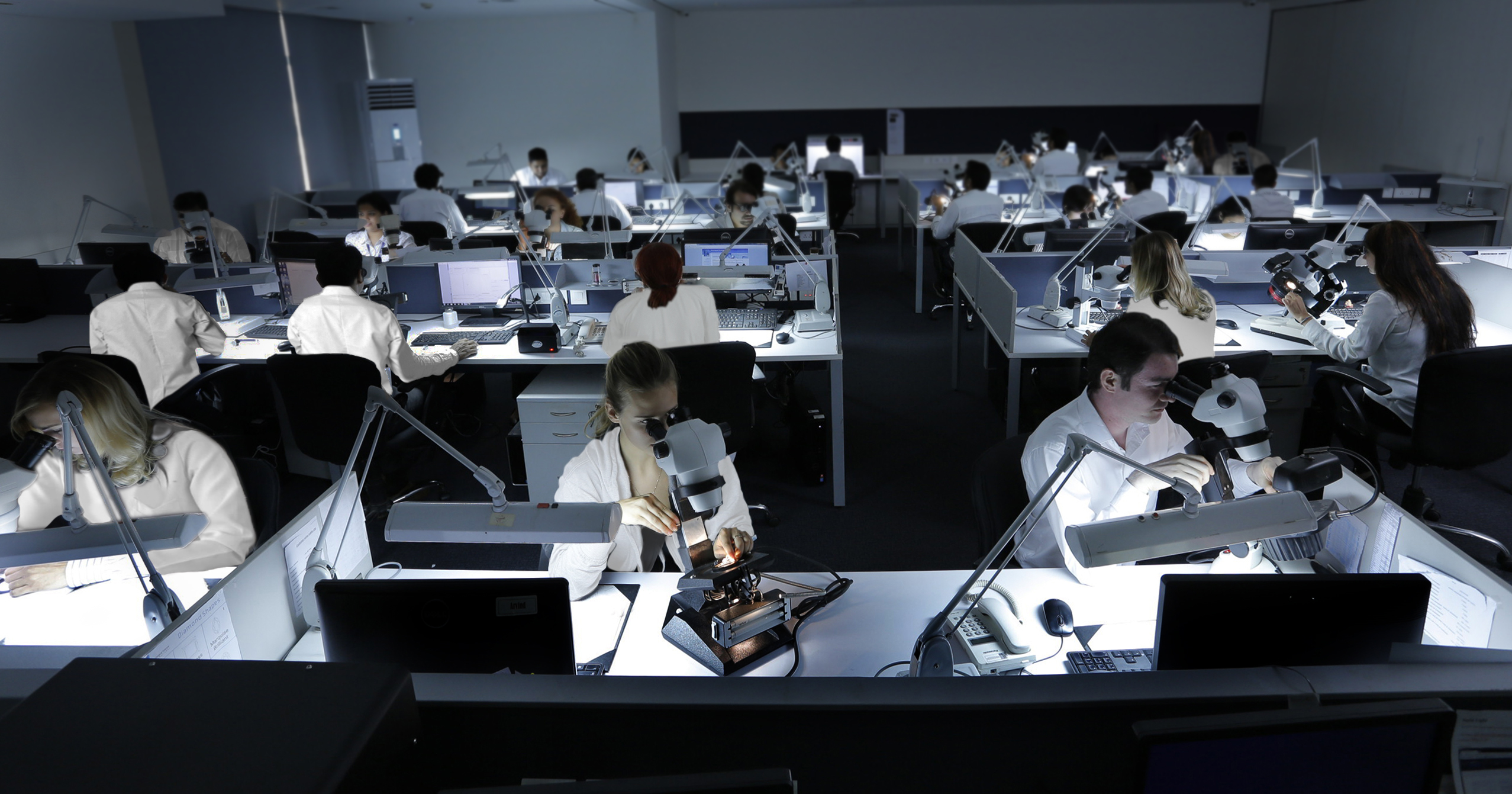
The diamond industry has undergone a remarkable transformation in how it approaches laboratory-grown diamond screening and verification. While the primary concern a decade ago centered on identifying undisclosed synthetic diamonds within natural diamond parcels, today’s challenges extend far beyond detection. Product integrity now encompasses verification of natural and laboratory-grown diamonds, identification of simulants, screening of mounted jewelry, and ensuring consistency across increasingly complex global supply chains.
Quick Summary
- Laboratory-grown diamond screening has evolved from simple detection to comprehensive product integrity verification.
- Modern screening addresses both undisclosed LGDs in natural diamond goods and natural diamonds in LGD products.
- Advanced technologies such as FTIR, Raman spectroscopy, photoluminescence, and deep-UV imaging have improved detection capabilities.
- Mounted jewelry screening presents greater challenges than loose diamond testing.
- High-volume retail screening requires operational discipline, quality control, and standardized procedures.
- Simulants and treated stones remain important concerns in product verification.
- AI can support screening efficiency but cannot replace gemological expertise.
- Product integrity has become a critical component of responsible diamond supply chain management.
Introduction: The Shift from Detection to Product Integrity
From Detection to Product Integrity: How Undisclosed Laboratory-Grown Diamond Screening Has Changed Over the Last Decade
Ten years ago, the diamond industry viewed undisclosed laboratory-grown diamonds as a serious but relatively narrow identification challenge. The primary concern was whether synthetic diamonds were being mixed into parcels of natural diamonds and whether laboratories had the right instruments to detect them.
Today, the issue is far broader.
The challenge is no longer limited to identifying undisclosed laboratory-grown diamonds in natural diamond parcels. The industry now also faces the reverse problem: natural diamonds being mixed into laboratory-grown diamond jewelry or parcels, incorrectly represented products, diamond simulants, treated stones, and inconsistent screening practices across the supply chain.
What was once primarily a gemological detection issue has become a much larger question of product integrity.
The Situation Ten Years Ago
A decade ago, most laboratory-grown diamonds encountered in the trade were relatively easier to separate from natural diamonds. Many HPHT and CVD-grown diamonds displayed characteristics that could be identified through fluorescence reactions, phosphorescence, growth structures, strain patterns, or spectroscopic features.
The challenge for laboratories at that time was mainly to build the correct scientific foundation:
- acquire the right instruments,
- train gemologists,
- understand the growing technologies,
- establish screening protocols,
- and educate the trade that the risk was real.
The industry was still learning what undisclosed laboratory-grown diamonds meant for manufacturers, retailers, and consumers. At that stage, many businesses assumed the issue was occasional, limited mostly to loose stones, and manageable through basic screening.
GSI was among the laboratories that recognized early that this issue would not remain small or simple. From the beginning, GSI invested in screening systems, advanced testing, research, and operational workflows capable of supporting not only individual testing, but large-volume screening for retailers and manufacturers.
That early experience became critical as the issue expanded.
What Changed for the Better
In many ways, the industry is much better equipped today than it was ten years ago.
There are now more instruments available, greater awareness, better-trained gemologists, and stronger recognition among major retailers that screening is an essential part of product integrity. Large manufacturers and retailers understand that screening cannot be an afterthought.
The trade has also moved from denial to acceptance. Ten years ago, many companies still treated undisclosed laboratory-grown diamonds as an occasional problem. Today, the industry understands that any serious supply chain must include a screening and verification program.
Technology has improved as well. Modern laboratories have access to more advanced systems, including:
- fluorescence-based screening
- FTIR spectroscopy
- photoluminescence spectroscopy
- Raman spectroscopy
- deep-UV imaging
- phosphorescence analysis
- low-temperature testing
These tools have made identification more accurate and more scalable than in the past.
But better tools do not mean the problem is solved.
What Changed for the Worse
While detection technology has improved, laboratory-grown diamonds have also improved.
Modern CVD and HPHT diamonds can be more sophisticated, more consistent, and in some cases more difficult to separate from natural diamonds using basic screening tools alone. Post-growth treatments can further complicate the identification process by altering color, reducing obvious diagnostic features, or changing optical behavior.
The challenge is no longer simply that laboratory-grown diamonds exist. The challenge is that they increasingly overlap with natural diamonds in ways that require more advanced analysis and interpretation.
The Growing Challenge of Volume
Another major change is volume.
Ten years ago, many laboratories were dealing with individual stones or relatively small parcels. Today, major retailers may require screening of thousands of finished jewelry items, containing hundreds of thousands or even millions of stones. This changes everything.
While a laboratory may be able to correctly identify an individual loose stone under ideal conditions, reliably screening thousands of mounted jewelry pieces under commercial production timelines is a far more complex and challenging process.
Loose Diamonds vs Mounted Jewelry
Loose diamonds are always easier to test than mounted diamonds.
With loose stones, the laboratory has full access to the diamond. The stone can be positioned properly, tested from different directions, and analyzed without interference from metal, settings, other stones, or design limitations.
Mounted jewelry is very different.
In jewelry, stones may be:
- partially covered by metal
- set at different depths
- difficult to access
- grouped closely together
- mixed with other stones
- too small for certain testing methods
A single ring, bracelet, or necklace may contain dozens or hundreds of diamonds. Some may be natural, some may be laboratory-grown, and some may even be simulants. Testing mounted jewelry requires not only instruments, but workflow design, experienced operators, quality control systems, and a clear escalation process for stones requiring further testing.
This is one of the areas where GSI’s experience has been especially important. GSI has worked for years with major retailers and manufacturers on high-volume jewelry screening programs, where the question is not simply “Can you identify this stone?” but “Can you protect an entire program consistently and at scale?”
From Dozens of Items to Thousands
There is a significant difference between screening a few dozen items and screening thousands.
Small-volume screening can often be handled manually with more flexibility. High-volume screening requires:
- standardized procedures
- trained teams
- internal checks
- data tracking
- consistent equipment calibration
- reporting discipline
- the ability to handle exceptions quickly
At scale, even a small weakness in procedure can become a major problem. A 1% uncertainty rate may be manageable in a small parcel, but in a program involving hundreds of thousands of stones, that same percentage becomes a serious operational issue.
This is why experience matters. Screening at scale is not only a gemological challenge. It is an operational discipline.
Most labs:
- treat screening as a separate department
- a stand-alone service
- an additional verification step
Screening at Scale Requires More Than Instruments
One of the most important changes over the past decade is the realization that effective screening is not simply about having access to instruments. The real challenge is maintaining consistency, reliability, and operational control while processing extremely large volumes of diamonds and jewelry across multiple manufacturing regions and supply chains.
There is a significant difference between screening a small number of loose stones under ideal laboratory conditions and managing continuous high-volume verification programs involving thousands of jewelry items and hundreds of thousands or even millions of diamonds.
At scale, screening becomes part of a much larger operational system involving:
- standardized procedures
- quality-control protocols
- instrument calibration
- escalation pathways
- data management
- workflow integration
- staff training
- continuous verification processes
Even minor inconsistencies between offices, operators, or procedures can create significant risks when programs operate across multiple locations and high production volumes.
One of GSI’s key strengths over the years has been its ability to develop a universal and integrated approach to screening and verification across its global operations.
Regardless of whether goods are processed in India, the United States, Thailand, Hong Kong, Dubai, or other GSI locations, the objective is to maintain consistency in methodology, operational protocols, quality-control procedures, and escalation standards.
This is particularly important for major retailers and manufacturers operating globally, where consistency between locations is often as important as testing itself.
At GSI, screening is not treated as a separate or isolated service. Instead, it is integrated into the broader structure of the laboratory’s operational and quality-assurance processes. Verification protocols, QC procedures, jewelry examination, grading workflows, and screening systems are interconnected parts of a larger product-integrity framework.
This integration becomes increasingly critical in today’s environment, where the challenge is no longer limited to identifying undisclosed laboratory-grown diamonds in loose parcels, but also includes:
- mounted jewelry
- mixed goods
- simulants
- reverse verification of natural diamonds within LGD goods
- large-scale retail supply-chain protection
As the industry continues to evolve, laboratories capable of combining scientific expertise with operational scale, consistency, and integrated global procedures will play an increasingly important role in maintaining confidence throughout the diamond and jewelry supply chain.
The Reverse Problem: Natural Diamonds in LGD Goods
Another major change is that the industry now faces the reverse issue as well.
Originally, the main concern was undisclosed laboratory-grown diamonds being mixed into natural diamond goods. Today, as laboratory-grown diamonds have become a major commercial category, the industry also needs to verify that goods represented as laboratory-grown are actually laboratory-grown.
Natural diamonds may appear in LGD jewelry or parcels for various reasons: inventory confusion, manufacturing errors, supplier mistakes, or intentional misrepresentation.
This matters because product integrity must work in both directions. Consumers who buy natural diamonds deserve confidence that they are natural. Consumers who buy laboratory-grown diamonds also deserve confidence that the product is properly represented.
The question is no longer only “Is this diamond natural?”
It is also “Is this product exactly what it claims to be?”
Simulants: The Forgotten Part of the Problem
The discussion often focuses on natural versus laboratory-grown diamonds, but simulants remain an important part of product integrity.
Moissanite, cubic zirconia, glass, synthetic colorless stones, and other diamond simulants can enter jewelry through errors, substitutions, repairs, or weak quality-control systems. In some cases, simulants may be found alongside natural or laboratory-grown diamonds in the same jewelry item.
This is especially important in finished jewelry, where individual stones may be small and difficult to access.
A complete screening program must therefore address:
- natural diamonds
- laboratory-grown diamonds
- diamond simulants
- treatments
- inconsistencies between product description and actual contents
Anything less is not a full product’s integrity.
The Problem of Overstated Instrument Claims
One of the challenges today is the marketing of screening instruments with claims that are too broad or too absolute.
Some instruments are extremely useful screening tools. However, no single instrument can solve every identification challenge under every condition, especially in mounted jewelry and high-volume production environments.
Screening instruments may be excellent at separating certain categories of diamonds, but responsible laboratories understand the difference between:
- screening
- referral
- confirmation
- final identification
The danger arises when users treat a screening result as a definitive conclusion without proper follow-up testing. This can create false confidence and expose retailers, manufacturers, and consumers to risk.
A serious laboratory must understand both the strength and the limitations of each technology.
Under-Equipped Laboratories and Cutting Corners
As demand for screening has increased, more service providers have entered the market. Not all are fully equipped to handle the complexity of today’s diamond identification challenges.
Some laboratories rely too heavily on limited screening tools. Others may lack advanced spectroscopy, imaging capabilities, experienced gemologists, or proper procedures for mounted jewelry. In some cases, commercial pressure for low prices and fast turnarounds may encourage shortcuts.
This is dangerous.
When screening is treated as a commodity service, the risk increases. The cost of a missed identification can be far greater than the cost of proper testing.
GSI’s position has always been that screening must be supported by science, expertise, and operational discipline. Instruments are essential, but instruments alone are not enough.
Can AI Help?
Artificial intelligence will certainly play a role in the future of diamond screening.
AI may help with:
- image recognition
- pattern detection
- sorting support
- workflow efficiency
- anomaly detection
- interpretation of large data sets
In high-volume environments, AI can become a valuable assistant by identifying patterns, reducing repetitive manual work, and helping laboratories process large quantities of data more efficiently.
However, AI will not replace gemological science.
AI cannot compensate for poor instrumentation, incomplete data, weak procedures, or lack of expert interpretation. It cannot identify what the underlying system is not capable of measuring. It also depends heavily on the quality and depth of the data used to train it.
In other words, AI can help laboratories become faster and more consistent, but it is not a substitute for advanced analytical testing and experienced gemologists.
Will the Problem Fade Away?
The issue of undisclosed laboratory-grown diamonds will not simply disappear.
It may change form, but it will persist because the diamond supply chain is complex, global, and constantly evolving. As long as natural diamonds, laboratory-grown diamonds, and simulants coexist in the market, verification will remain necessary.
In fact, the need for screening may become even more important as the trade becomes more segmented. Natural diamond programs, laboratory-grown diamond programs, and mixed-category retailers will all need reliable verification systems.
The future is not a world without screening. The future is a world where screening becomes a normal, expected part of responsible diamond and jewelry supply chain management.
GSI’s Role Then and Now
GSI was involved in this challenge from the early stages, when many in the trade still underestimated the scale of the issue. Over the years, GSI developed extensive experience in screening loose diamonds, finished jewelry, and high-volume retail programs.
Today, GSI’s role is broader than identification alone.
GSI supports the industry through:
- large-scale screening programs
- verification of natural and laboratory-grown diamond jewelry
- detection of simulants
- quality assurance
- research
- education
- customized programs for retailers and manufacturers
This combination of gemological expertise and operational scale is especially important today. Retailers do not only need answers on individual stones. They need systems that protect their brands, their vendors, and their consumers.
Conclusion
The separation of natural diamonds, laboratory-grown diamonds, and simulants has evolved dramatically over the past decade.
Ten years ago, the industry was focused mainly on detecting undisclosed laboratory-grown diamonds in natural diamond parcels. Today, the challenge is far more complex. Laboratories must verify product integrity in both directions, work with mounted jewelry, handle enormous volumes, recognize simulants, understand the limitations of instruments, and adapt to rapidly changing diamond growth and treatment technologies.
The problem has become more sophisticated but so has the response.
For the industry, the lesson is clear: responsible screening requires more than a device. It requires science, experience, infrastructure, consistency, and willingness to continuously adapt.
That is where experienced laboratories such as GSI play a critical role, not only in identifying diamonds, but in helping protect the integrity of the entire jewelry supply chain.
About GSI
Gemological Science International (GSI) is the only major gemological organization established in the 21st century. Founded in 2005 in New York City, it has grown to become one of the largest gemological entities in the world with laboratory facilities spanning four continents. Utilizing cutting-edge processes and proprietary technologies, along with a commitment to the highest ethical standards and practices, GSI provides manufacturers and retailers globally with a wide range of gemstone identification and grading services. The company is committed to advancing gemological research and offers gemological educational programs for trade professionals and the general public.
FAQs
What is undisclosed laboratory-grown diamond screening?
It is the process of identifying laboratory-grown diamonds that have been mixed into natural diamond parcels or jewelry without proper disclosure.
Why is product integrity important in the diamond industry?
Product integrity ensures that diamonds and jewelry are accurately represented, giving consumers confidence in what they are purchasing.
Why is mounted jewelry harder to screen than loose diamonds?
Mounted jewelry restricts access to stones due to metal settings, positioning, and proximity to other stones, making testing more complex.
Can a single screening instrument identify every diamond correctly?
No. Screening tools are valuable, but proper identification often requires multiple technologies, expert analysis, and confirmation testing.
How can AI support diamond screening?
AI can assist with image recognition, anomaly detection, workflow efficiency, and data analysis, but it cannot replace gemological expertise.
Will diamond screening remain important in the future?
Yes. As natural diamonds, laboratory-grown diamonds, and simulants continue to coexist in the market, screening will remain a critical component of responsible supply chain management.
Source: SVAR Media Network
About SVAR Media Network – India’s Best Source for Jewellery News, Magazines, Newsletters and Media
SVAR Media Network is India’s No. 1 Destination for Jewellery News, setting the gold standard in timely, trusted, & trend-driven coverage across the Gems & Jewellery industry. As the Most Followed Jewellery Magazine & Media House in India, SVAR delivers Daily Jewellery News India Updates, market insights, & global developments through its platforms like Jewellery Magazine, Newsletters, AI Powered News Bulletins, Website, Social Media, Podcasts, & much more.
Recognized as Asia’s one of the Best Media in Jewellery & one of the World’s Best Jewellery Media, SVAR Media Network sets Unparalleled Standards in the Gems & Jewellery industry. SVAR is the Most Trusted & Widely Read Voice in the Gems & Jewellery Community.
Renowned as India’s Best Jewellery Magazine & Leading Jewellery Media, SVAR blends legacy with cutting-edge innovation by delivering:
- Best in class Jewellery Magazine for the Gems & Jewellery Industry & Jewellery Enthusiasts
- Real-time AI-Powered Jewellery News via SVARA AI, the World’s First AI Anchor in Fashion, Gems & Jewellery Industry
- India’s One of the First Gems & Jewellery Podcasts
- Digital Jewellery Newsletters for professionals and enthusiasts
- ISO 9001:2015 Certification, the first in the jewellery-media sector, proving our commitment to excellence
- Asia’s First & World’s Second Meta Verified Jewellery Media Brand

Ranked #1 among the Top 5 Gems & Jewellery News Websites, Top 10 Jewellery Magazines in India, & Most Influential Jewellery Media Brands, SVAR Media Network is your Trusted Source for Accurate, Fast, & Future-Focused Jewellery News.
SVAR Media Network is India’s No 1 Digital Media in Jewellery Industry & continues to be the Leading Jewellery Magazine & a Global Leader in Jewellery Media. SVAR Media Network offers a diverse range of services, including: Monthly Magazines, Digital Newsletters, Al-Driven News Bulletins, Social Media Promotions, Website Blogs & Articles, WhatsApp Updates, Podcasts & more…
Whether you seek updates on New Launches, Trade Shows, Celebrity Campaigns, Trends or Market Movements, SVAR is the Authority in Jewellery News India & beyond.
Explore the World of Gems & Jewellery with SVAR Media Network — Your Best Source for Trusted, Trend-Setting Jewellery News & Mediapp Updates, Podcasts & more…