India’s gold market entered a new phase of import tightening in May 2026 after the government raised gold import duty sharply from 6% to 15%, marking the steepest increase on record. According to the World Gold Council’s India Gold Market Update, the move forms part of broader regulatory and administrative measures aimed at moderating imports and managing pressure on India’s external balances.
Quick Summary
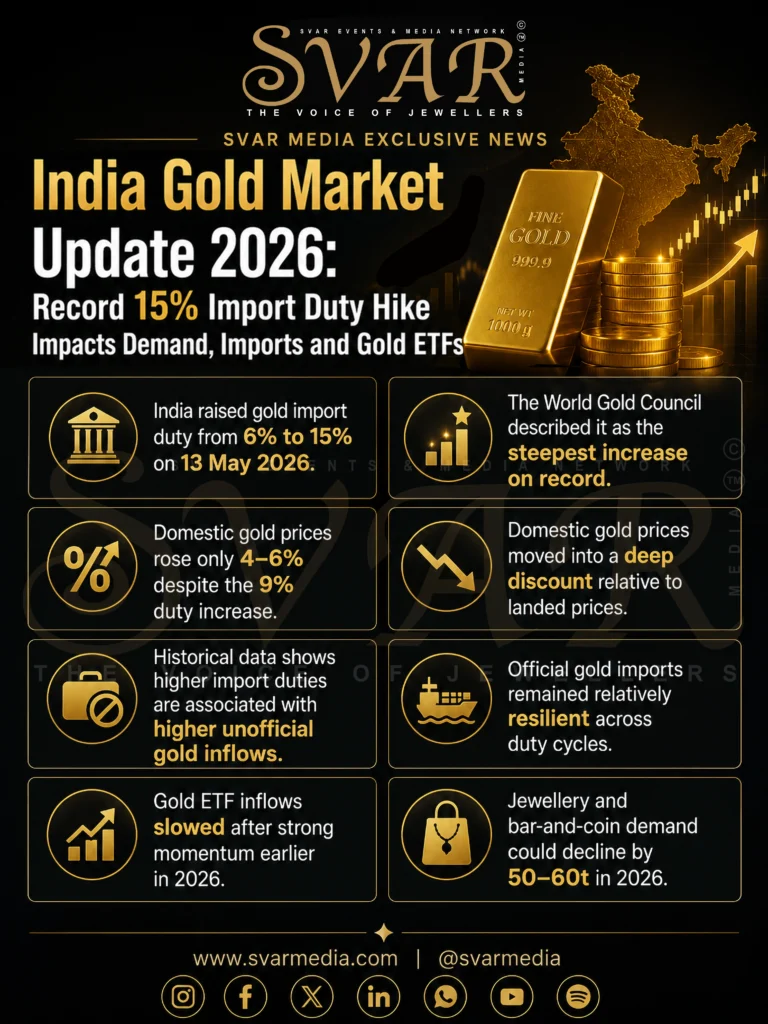
- India raised gold import duty from 6% to 15% on 13 May 2026.
- The World Gold Council described it as the steepest increase on record.
- Domestic gold prices rose only 4–6% despite the 9% duty increase.
- Domestic gold prices moved into a deep discount relative to landed prices.
- Historical data shows higher import duties are associated with higher unofficial gold inflows.
- Official gold imports remained relatively resilient across duty cycles.
- Gold ETF inflows slowed after strong momentum earlier in 2026.
- Jewellery and bar-and-coin demand could decline by 50–60t in 2026.
India’s Gold Market Update: Import Tightening and Duty Hike Impact
Analysis based on the World Gold Council report by Kavita Chacko, Research Head, India
Highlights
- Gold import duty was raised sharply by 9% — from 6% to 15%, the steepest increase on record — alongside broader regulatory tightening.
- Domestic gold prices have not yet fully reflected the duty hike amid weak demand and ample supply; local markets are currently in deep discount from the landed price.
- Past trends indicate that higher duty increases unofficial inflows, although official imports remain relatively resilient.
- Gold demand is expected to moderate in 2026, with jewellery and bar and coin demand projected to decline by 50–60t (~10% y/y) on account of the import duty hike.
Import Tightening Measures
Since early April, the government has adopted a series of measures aimed at moderating gold imports. These have been part of a broader push to conserve foreign exchange reserves amid geopolitical uncertainty and mounting pressure on the INR, which has depreciated by more than 7% y-t-d.
These measures include price-based actions, administrative and regulatory tightening, and consumer-directed messaging. Gold accounted for 8% of India’s merchandise imports in 2025, and similar measures have been used previously.
The measures included:
- Restrictions on the import of all forms of gold, silver and platinum jewellery and platinum alloys.
- Delays in issuing annual licences for bullion imports to banks.
- Delay in issuing notification exempting banks from the Integrated Goods and Services Tax (IGST), leading banks to pause bullion imports for over a month.
- Tightening rules for gold imports linked to exports under the advance authorisation scheme.
- A direct appeal from the Prime Minister urging consumers to avoid buying gold for a year.
- The increase in import duty from 6% to 15%.
India’s Gold Import Duty Revisions
| Revision Date | Revision | Gap Since Previous Change (Months) |
|---|---|---|
| 16 January 2012 | ▲ +2% | — |
| 16 March 2012 | ▲ +2% | 2 |
| 21 January 2013 | ▲ +2% | 10 |
| 5 June 2013 | ▲ +2% | 5 |
| 13 August 2013 | ▲ +2% | 2 |
| 6 July 2019 | ▲ +2.5% | 71 |
| 2 February 2021 | ▼ −1.75% | 19 |
| 1 July 2022 | ▲ +4.25% | 17 |
| 24 July 2024 | ▼ −9% | 25 |
| 13 May 2026 | ▲ +9% | 22 |
Source: CBIC, World Gold Council
Duty Revisions Have Become More Frequent
Gold imports were subject to a flat duty prior to 2012 before India moved to a value-based duty structure.
Between 2012 and 2013 duties were raised repeatedly through a series of 2% hikes, eventually reaching 10%. After a long period of stability, revisions became more frequent and larger in magnitude, including duty cuts in 2021 and 2024 and sharp hikes in 2022 and 2026.
According to the World Gold Council, this reflects “a more active use of import duties to manage trade dynamics.”
Domestic Prices Have Not Fully Adjusted
- The import duty hike led to an immediate increase in domestic gold prices, but the rise has been lower than the increase in duty itself.
- Physical market prices, represented by the MCX spot gold price, rose by around 4–6% after the duty revision despite the 9% increase in duty.
- The World Gold Council notes that physical market prices adjust with a lag, particularly when the duty change is as steep as the current increase.
- The timing also coincided with a seasonally weak demand period, after summer wedding purchases and during a traditionally inauspicious period for gold buying between mid-May and mid-June.
- At the same time, supply remained ample due to exchange of old jewellery for new, profit-taking by investors, and likely front-loading of imports.
Domestic Gold Discounts Deepened Sharply
Domestic gold prices moved into a steep discount relative to official landed prices following the duty increase.
The discount widened from an average of US$14/oz before the hike to nearly US$150/oz afterwards.
According to the report, previous duty hikes in 2019 and 2022 also resulted in discounts in the domestic market, but the current episode has been significantly more pronounced because of the scale of the increase.
Post-Duty Hike Movement in Domestic Gold Price Discounts (US$/oz)
| Duty Hike Date | Duty Hike (%) | T-1 | T+1 | T+3 |
|---|---|---|---|---|
| Jul-19 | 2.9 | -15 | -15 | -17.5 |
| Jul-22 | 4.3 | -5 | -24 | -22 |
| May-26 | 9.0 | -29 | -145 | -130 |
Source: NCDEX, World Gold Council
Jewellery Industry Reaction
Share prices of listed jewellers fell by approximately 2%–17% following the duty hike, reflecting expectations of weaker discretionary demand.
The World Gold Council noted varying responses across the industry:
- Large chain stores saw brief panic buying immediately after the announcement and remain relatively resilient because of inventory buffers and bridal demand.
- Mid-sized and regional jewellers continue seeing purchases from affluent customers but expect greater reliance on exchange programmes and tighter inventory cycles.
- Smaller retailers appear most vulnerable because of pressure on both sales volumes and margins.
Import Duties and Smuggling
The report highlights a consistent relationship between higher import duties and unofficial gold inflows.
Between 2013 and 2026, increases in import duty were generally followed by higher levels of unofficial or smuggled gold, while duty reductions coincided with declines in such inflows.
Excluding the COVID years of 2020–21, the correlation between import duty and unofficial imports was positive at 0.52.
Following the 4% duty hike in 2013:
- Unofficial imports rose from around 10t in Q1 2013 to 70t by Q1 2014.
- Unofficial inflows remained elevated at an average of 34t per quarter while duties remained at 10%.
After the July 2022 duty hike from 10.75% to 15%:
- Unofficial imports increased from 17t in Q2 2022 to nearly 50t by late 2022.
- Elevated levels continued through much of 2023.
After the July 2024 duty reduction to 6%, unofficial imports fell almost immediately to near zero.
The World Gold Council states that higher import duties widen the domestic–international price gap and increase incentives for smuggling.
Official Imports Remain Resilient
- The World Gold Council’s analysis suggests import duty changes have had limited influence on official import volumes during the last 13 years.
- Across duty regimes ranging from 6% to 15%, official imports generally remained between 175t and 236t per quarter, excluding the COVID period.
- The highest quarterly imports occurred under the 10.75% duty regime at 236.2t.
- The correlation between duty rates and official imports was calculated at negative 0.17, indicating a weak relationship.
- Average Quarterly Official Imports at Various Duty Levels
| Import Duty % and Period | Average Quarterly Official Imports |
|---|---|
| 10% (Q3’13 – Q2’19) | ~205t |
| 12.5% (Q3’19 – Q4’20) | ~115t |
| 10.75% (Q1’21 – Q2’22) | ~236t |
| 15% (Q3’22 – Q2’24) | ~175t |
| 6% (Q3’24 – Q1’26) | ~195t |
Source: DGCIS, CBIC, World Gold Council
April 2026 Imports Increased Sharply
- April 2026 imports rose to US$5.6bn, increasing more than 80% on both an annual and sequential basis despite banks pausing bullion imports.
- The report suggests this was likely driven by refiners increasing gold doré intake around Akshaya Tritiya, supported by gold price moderation.
- The World Gold Council also noted anecdotal evidence suggesting some front-loading of imports ahead of potential further restrictions amid the Iran-US conflict, elevated oil prices, and INR vulnerability.
- Estimated imports during April were placed at 48–55t.
Gold ETFs: Flows Slow
Indian gold ETFs recorded their twelfth consecutive month of positive inflows in April 2026.
Gold ETF Metrics – April 2026
| Metric | Value |
|---|---|
| Net inflows | INR30.4bn (US$325mn) |
| Sequential inflow growth | +3% m/m |
| January peak comparison | ~13% of INR240bn |
| Redemptions | INR20.5bn (US$220mn) |
| Holdings increase | +1.1t to 116.7t |
| Total AUM | INR1,781bn (US$19bn) |
| AUM change from January | -3% |
| Total folios | 12.5mn |
| Folio additions in April | 77,413 |
Source: AMFI, ICRA Analytics, CMIE, World Gold Council
Inflows remained well below January’s peak levels, signalling moderation after a strong start to the year.
Redemptions remained elevated because of continued profit-taking trends.
Following the import duty hike, ETFs experienced outflows between 13–18 May, although month-to-date demand remained marginally positive at around INR1bn (~US$12mn).
Demand Moderation
The World Gold Council stated that import duties influence gold demand alongside broader factors including prices, inflation, and income growth.
Higher import duty periods have generally coincided with weaker demand, particularly in bars and coins.
Average Jewellery and Bar and Coin Demand at Various Import Duty Levels
| Import Duty % and Period | Average Demand |
|---|---|
| 2% (2012) | ~200t |
| 4% (2012) | ~210t |
| 6% (2013) | ~320t |
| 8% (2013) | ~270t |
| 10% (2013–19) | ~205t |
| 12.5% (2019–20) | ~155t |
| 10.75% (2021–22) | ~205t |
| 15% (2022–24) | ~200t |
| 6% (2024–26) | ~270t |
Source: Metal Focus, CBIC, World Gold Council
Demand Outlook for 2026
- The World Gold Council’s econometric models suggest that import duties impact gold demand in both the short and long term.
- Investment demand appears more sensitive to duty changes, while jewellery demand has shown greater resilience because jewellery purchases are often linked to weddings and social occasions.
- Investment demand is influenced by income levels, import duties, inflation, and rainfall.
- The World Gold Council estimates that combined jewellery and bar-and-coin demand could decline by around 50–60t in 2026, approximately 10% lower than the previous year because of the import duty hike.
- The report also notes that gold prices, income levels, inflation, and monsoon conditions will continue influencing annual demand trends.
FAQs
What is India’s new gold import duty rate?
India increased gold import duty from 6% to 15% in May 2026.
Why did India tighten gold imports?
The measures were introduced to moderate imports and manage pressure on foreign exchange reserves and the Indian rupee.
How much have domestic gold prices increased after the duty hike?
According to the World Gold Council, physical market prices increased by around 4–6%.
What happened to domestic gold discounts after the hike?
Discounts widened sharply from around US$14/oz before the hike to nearly US$150/oz afterwards.
Did the World Gold Council find a link between higher duties and smuggling?
Yes. The report states that higher import duties are associated with higher unofficial gold inflows.
What is the gold demand outlook for 2026?
The World Gold Council estimates jewellery and bar-and-coin demand could decline by around 50–60t during 2026.
Source: SVAR Media Network
About SVAR Media Network – India’s Best Source for Jewellery News, Magazines, Newsletters and Media
SVAR Media Network is India’s No. 1 Destination for Jewellery News, setting the gold standard in timely, trusted, & trend-driven coverage across the Gems & Jewellery industry. As the Most Followed Jewellery Magazine & Media House in India, SVAR delivers Daily Jewellery News India Updates, market insights, & global developments through its platforms like Jewellery Magazine, Newsletters, AI Powered News Bulletins, Website, Social Media, Podcasts, & much more.
Recognized as Asia’s one of the Best Media in Jewellery & one of the World’s Best Jewellery Media, SVAR Media Network sets Unparalleled Standards in the Gems & Jewellery industry. SVAR is the Most Trusted & Widely Read Voice in the Gems & Jewellery Community.
Renowned as India’s Best Jewellery Magazine & Leading Jewellery Media, SVAR blends legacy with cutting-edge innovation by delivering:
- Best in class Jewellery Magazine for the Gems & Jewellery Industry & Jewellery Enthusiasts
- Real-time AI-Powered Jewellery News via SVARA AI, the World’s First AI Anchor in Fashion, Gems & Jewellery Industry
- India’s One of the First Gems & Jewellery Podcasts
- Digital Jewellery Newsletters for professionals and enthusiasts
- ISO 9001:2015 Certification, the first in the jewellery-media sector, proving our commitment to excellence
- Asia’s First & World’s Second Meta Verified Jewellery Media Brand

Ranked #1 among the Top 5 Gems & Jewellery News Websites, Top 10 Jewellery Magazines in India, & Most Influential Jewellery Media Brands, SVAR Media Network is your Trusted Source for Accurate, Fast, & Future-Focused Jewellery News.
SVAR Media Network is India’s No 1 Digital Media in Jewellery Industry & continues to be the Leading Jewellery Magazine & a Global Leader in Jewellery Media. SVAR Media Network offers a diverse range of services, including: Monthly Magazines, Digital Newsletters, Al-Driven News Bulletins, Social Media Promotions, Website Blogs & Articles, WhatsApp Updates, Podcasts & more…
Whether you seek updates on New Launches, Trade Shows, Celebrity Campaigns, Trends or Market Movements, SVAR is the Authority in Jewellery News India & beyond.
Explore the World of Gems & Jewellery with SVAR Media Network — Your Best Source for Trusted, Trend-Setting Jewellery News & Mediapp Updates, Podcasts & more…