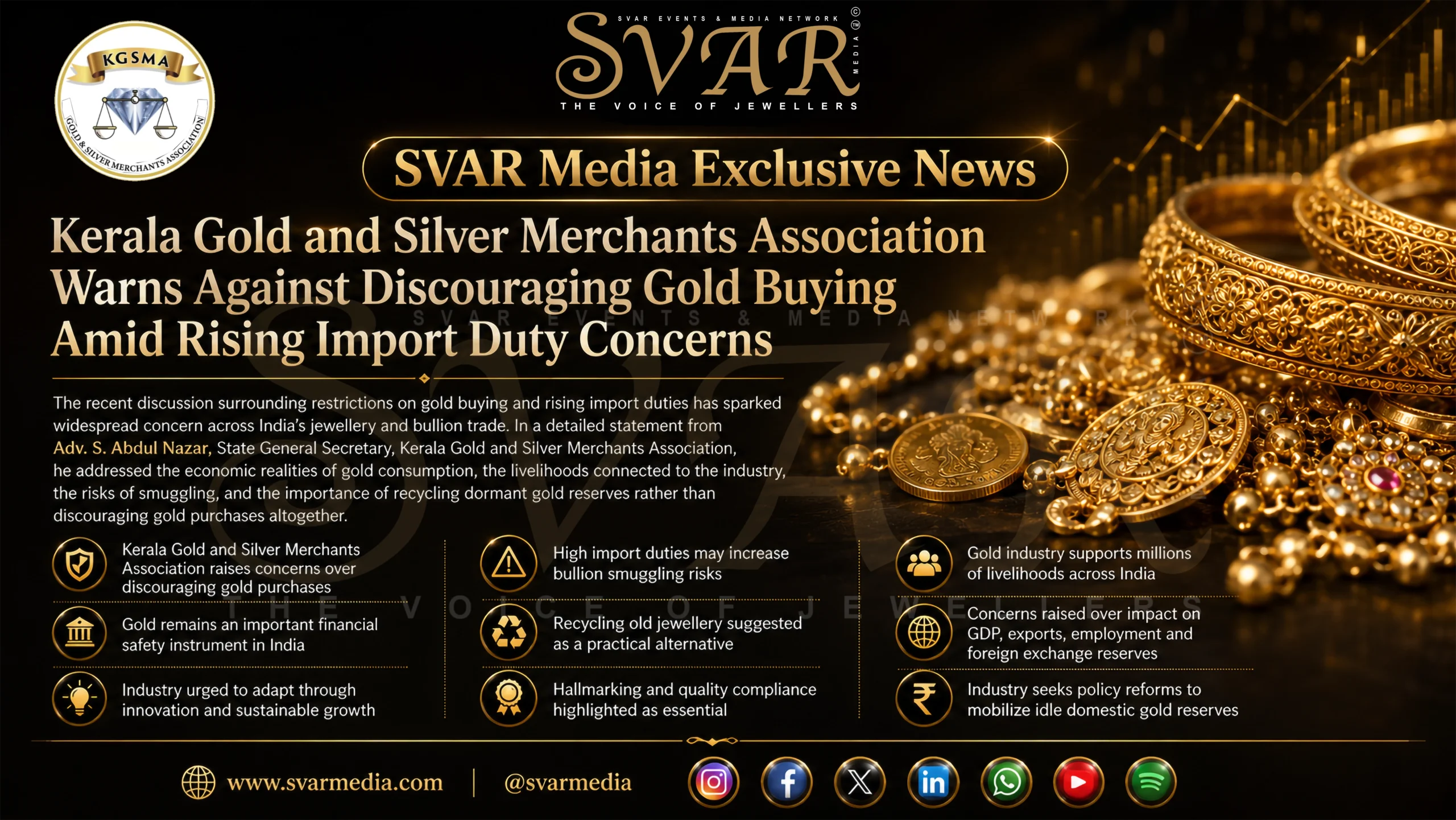
The recent discussion surrounding restrictions on gold buying and rising import duties has sparked widespread concern across India’s jewellery and bullion trade. In a detailed statement from Adv. S. Abdul Nazar, State General Secretary, Kerala Gold and Silver Merchants Association, he addressed the economic realities of gold consumption, the livelihoods connected to the industry, the risks of smuggling, and the importance of recycling dormant gold reserves rather than discouraging gold purchases altogether.
Quick Summary
- Kerala Gold and Silver Merchants Association raises concerns over discouraging gold purchases
- Gold remains an important financial safety instrument in India
- Industry urged to adapt through innovation and sustainable growth
- High import duties may increase bullion smuggling risks
- Recycling old jewellery suggested as a practical alternative
- Hallmarking and quality compliance highlighted as essential
- Gold industry supports millions of livelihoods across India
- Concerns raised over impact on GDP, exports, employment and foreign exchange reserves
- Industry seeks policy reforms to mobilize idle domestic gold reserves
Adv. S. Abdul Nazar Issues Statement on Discouraging Gold Buying and Rising Import Duty Concerns
Kerala Gold and Silver Merchants Association State General Secretary Highlights Realities and Challenges Facing India’s Gold Trade
Statement on not buying gold: Increase in import duty, concerns and realities in the gold trade and industry by Adv. S. Abdul Nazar, State General Secretary, Kerala Gold and Silver Merchants Association.
Concerns Raised Following Prime Minister’s Appeal
The recent call by the Prime Minister for strict measures on the sale and use of gold has certainly created significant concerns in the jewellery trade.
Gold as More Than an Emotional Asset
Buying gold jewellery in India extends beyond emotions. Its importance varies across different economic segments of society. For some, jewellery represents fashion, prestige and personal expression; however, for many others, it serves as a hedge against inflation, a reliable investment, a safety net in times of emergency, and a safe financial instrument that can be converted into cash when needed. Therefore, buying jewellery cannot be simply restricted.
Industry Must Adapt Through Challenging Times
Trade should see this challenging phase as an opportunity to reinvent itself, identify new avenues for growth and sustain operations amidst the prevailing global uncertainties and economic pressures. It may take time for stability to return and market conditions to improve, but the industry must navigate this period with resilience, with a focus on gradual, sustainable growth.
Livelihood Impact Across the Jewellery Sector
For the jewellery sector, this is not just a commercial issue; it also directly affects the livelihoods of millions of people employed directly and indirectly by the industry, while contributing significant tax revenue to the national exchequer.
Need for Innovation and Adaptability
In line with the current economic realities and national sentiment, the trade must acknowledge, embrace and adhere to the appeal made by our esteemed Prime Minister. The industry needs to reinvent itself again and meet these challenges through innovation, adaptability and determination.
Concerns Over Bullion Smuggling
There is also a growing perception that high import duties may encourage bullion smuggling despite stringent enforcement measures. However, such practices do not benefit legitimate trade in precious metals at competitive and transparent costs.
Encouraging Jewellery Recycling
Instead, the industry should actively encourage consumers to recycle their old, unused, outdated or worn-out jewellery into fashion designs that suit today’s preferences. Such an initiative would unlock dormant gold reserves and bring them back into circulation as a valuable source of raw material for trade, with little or no additional financial burden on consumers.
Importance of Hallmarking and Compliance
Meanwhile, ensuring strict quality standards and compliance through the existing hallmarking framework would protect consumer interests and further strengthen trust in the industry. This approach would not only generate tax revenue for the government but would also help reduce the outflow of valuable foreign exchange.
Reviewing LTCG Tax Implications
In addition, policymakers and industry think tanks may consider reviewing the long-term capital gains (LTCG) tax implications of recycling and transferring old jewellery. Rationalizing these provisions will encourage the conversion of idle and unproductive gold assets into productive financial resources, thereby helping to create jobs, GDP growth, tax revenues and preserve valuable foreign exchange reserves.
Global Uncertainty and Market Repercussions
The proposal may have been made in view of the war situation in the Middle East, global economic uncertainty and the weakness of the rupee. However, in India, one of the largest gold consumers in the world, such a statement will have major market repercussions.
Pressure on Gold Sector Stocks
Following the statement, stocks related to the gold sector experienced huge pressure. The market value of some companies fell by 10 to 15 percent. Along with this, there is a tendency for the public to sell old gold on fears that gold prices may fall.
Importance of the Gold Sector to India’s Economy
The gold sector plays a major role in India’s domestic economy. The sector is linked to the livelihood of lakhs of people, including jewellery manufacturing, retail trade, exports, artisans, small traders, workers and allied service sectors. The role of the gold industry in India’s GDP and employment is crucial.
Impact of Gold Imports on CAD and Forex Reserves
With the Indian currency depreciating to 96.60 against the dollar, about Rs 12 lakh crore is going out of the country every year to import about 800 tonnes of gold. This is affecting the country’s Current Account Deficit (CAD) and foreign exchange reserves.
Policy Focus Should Be on Domestic Gold Circulation
But the solution to this is not to discourage buying gold. Rather, the government should adopt policies to bring the large gold reserves existing within the country into economic circulation.
FAQs
Why is the jewellery industry concerned about discouraging gold purchases?
The industry believes gold is not only a cultural asset but also a financial safeguard for millions of Indians. Restricting gold purchases may negatively impact trade, employment, and economic activity.
How does gold contribute to India’s economy?
The gold sector supports jewellery manufacturing, retail trade, exports, artisans, workers, and allied industries while contributing significantly to GDP, employment, and tax revenues.
What risks are associated with higher gold import duties?
There are concerns that higher import duties could encourage bullion smuggling, which may hurt legitimate businesses operating with transparent pricing and compliance standards.
What alternative solution has been suggested instead of discouraging gold buying?
The statement recommends encouraging recycling of old and unused jewellery to unlock dormant domestic gold reserves and reduce dependence on imports.
Why is hallmarking important for the jewellery industry?
Hallmarking helps maintain quality standards, protects consumer interests, and strengthens trust in the jewellery trade.
How do gold imports impact India’s foreign exchange reserves?
India imports around 800 tonnes of gold annually, resulting in significant foreign exchange outflow that affects the Current Account Deficit (CAD) and forex reserves.
Source: SVAR Media Network
About SVAR Media Network – India’s Best Source for Jewellery News, Magazines, Newsletters and Media
SVAR Media Network is India’s No. 1 Destination for Jewellery News, setting the gold standard in timely, trusted, & trend-driven coverage across the Gems & Jewellery industry. As the Most Followed Jewellery Magazine & Media House in India, SVAR delivers Daily Jewellery News India Updates, market insights, & global developments through its platforms like Jewellery Magazine, Newsletters, AI Powered News Bulletins, Website, Social Media, Podcasts, & much more.
Recognized as Asia’s one of the Best Media in Jewellery & one of the World’s Best Jewellery Media, SVAR Media Network sets Unparalleled Standards in the Gems & Jewellery industry. SVAR is the Most Trusted & Widely Read Voice in the Gems & Jewellery Community.
Renowned as India’s Best Jewellery Magazine & Leading Jewellery Media, SVAR blends legacy with cutting-edge innovation by delivering:
- Best in class Jewellery Magazine for the Gems & Jewellery Industry & Jewellery Enthusiasts
- Real-time AI-Powered Jewellery News via SVARA AI, the World’s First AI Anchor in Fashion, Gems & Jewellery Industry
- India’s One of the First Gems & Jewellery Podcasts
- Digital Jewellery Newsletters for professionals and enthusiasts
- ISO 9001:2015 Certification, the first in the jewellery-media sector, proving our commitment to excellence
- Asia’s First & World’s Second Meta Verified Jewellery Media Brand

Ranked #1 among the Top 5 Gems & Jewellery News Websites, Top 10 Jewellery Magazines in India, & Most Influential Jewellery Media Brands, SVAR Media Network is your Trusted Source for Accurate, Fast, & Future-Focused Jewellery News.
SVAR Media Network is India’s No 1 Digital Media in Jewellery Industry & continues to be the Leading Jewellery Magazine & a Global Leader in Jewellery Media. SVAR Media Network offers a diverse range of services, including: Monthly Magazines, Digital Newsletters, Al-Driven News Bulletins, Social Media Promotions, Website Blogs & Articles, WhatsApp Updates, Podcasts & more…
Whether you seek updates on New Launches, Trade Shows, Celebrity Campaigns, Trends or Market Movements, SVAR is the Authority in Jewellery News India & beyond.
Explore the World of Gems & Jewellery with SVAR Media Network — Your Best Source for Trusted, Trend-Setting Jewellery News & Mediapp Updates, Podcasts & more…