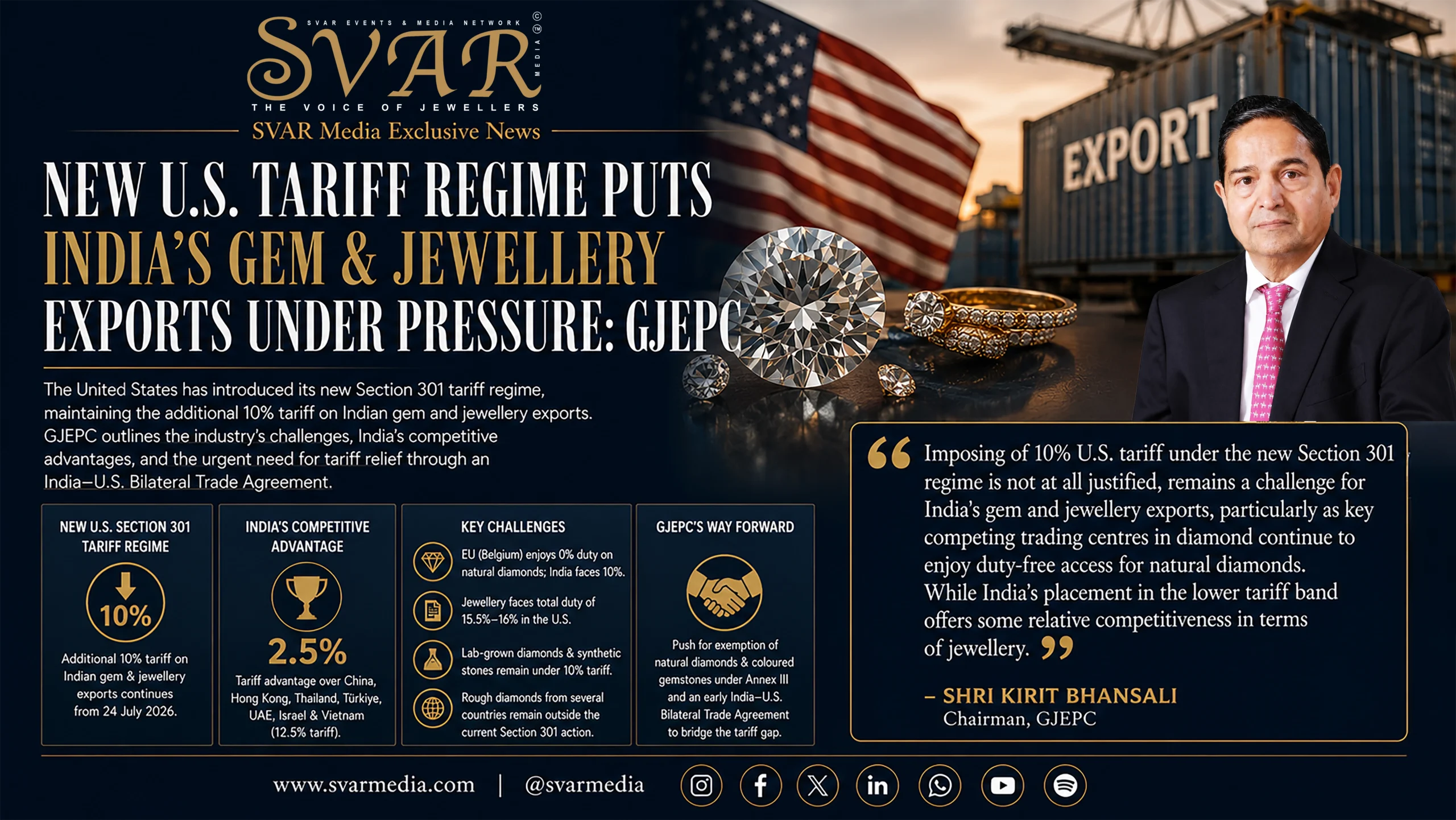
The United States has transitioned to a new Section 301 tariff regime while retaining the additional 10% tariff on Indian gem and jewellery exports. Although India has secured a comparatively favourable tariff position against several competing countries, the Gem & Jewellery Export Promotion Council (GJEPC) believes the continued tariff remains a significant challenge for exporters and is urging the Government of India to pursue an early Bilateral Trade Agreement with the U.S. to strengthen the sector’s global competitiveness.
Quick Summary
- U.S. has replaced the temporary Section 122 surcharge with the new Section 301 tariff regime.
- The additional 10% tariff on Indian gem and jewellery exports remains unchanged from 24 July 2026.
- India has secured a 2.5 percentage-point tariff advantage over several competing countries.
- GJEPC rejects any association of India’s gem and jewellery industry with forced labour.
- Natural diamonds and coloured gemstones continue to face tariff-related competitiveness challenges.
- GJEPC is urging an early India–U.S. Bilateral Trade Agreement to improve export competitiveness.
U.S. Introduces New Section 301 Tariff Framework
The Gem & Jewellery Export Promotion Council (GJEPC) has taken note of the United States’ transition from the temporary Section 122 balance-of-payments surcharge to the new Section 301 tariff regime, effective from 24 July 2026, under which the additional tariff on Indian gem and jewellery exports remains unchanged at 10%.
USTR Investigation Leads to New Tariff Regime
The new tariff framework follows the conclusion of investigations by the Office of the United States Trade Representative (USTR) into the implementation and enforcement of prohibitions on imports produced with forced labour across 60 economies.
India Retains Competitive Tariff Advantage
While the continuation of the 10% tariff presents ongoing challenges for Indian exporters, India has secured placement in the lower 10% tariff band after adopting a prohibition on forced labour imports. This provides Indian exporters with a 2.5 percentage-point tariff advantage over several competing manufacturing and trading hubs, including China, Hong Kong, Thailand, Türkiye, the UAE, Israel and Vietnam, all of which are now subject to a 12.5% additional tariff.
GJEPC Chairman Responds to the New Tariff
Shri Kirit Bhansali, Chairman, GJEPC, said, “At the outset, we categorically reject any implication that India’s gem and jewellery sector is linked to forced labour. Repeated studies have been commissioned that demonstrates the industry’s long-standing commitment to responsible sourcing, worker welfare, and ethical business practices. We also welcome the Government of India’s recent amendment to the Foreign Trade Policy that bars the import of goods produced, wholly or partly, with forced labour—an important step that reinforces India’s commitment to human rights and aligns our trade rules with internationally accepted labour standards.
“So imposing of 10% U.S. tariff under the new Section 301 regime, which is not at all justified, remains a challenge for India’s gem and jewellery exports, particularly as key competing trading centres in diamond continue to enjoy duty-free access for natural diamonds. While India’s placement in the lower tariff band offers some relative competitiveness in terms of jewellery, bridging the remaining tariff gap through an early India–U.S. Bilateral Trade Agreement and securing tariff relief for natural diamonds and coloured gemstones as provided to countries like EU, Malaysia remain our key priorities.”
Key Advantages for India
• India has been placed in the 10% tariff band, compared with the 12.5% tariff imposed on competing manufacturing and trading hubs such as China, Hong Kong, Thailand, Türkiye, the UAE, Israel and Vietnam.
• This provides Indian exporters with a 2.5 percentage-point competitive tariff advantage over these countries in the U.S. market.
Key Challenges for the Industry
• European Union (Belgium), a global diamond trading hub, continues to enjoy a 0% additional tariff on natural diamonds, while comparable Indian-origin diamonds attract a 10% duty, creating a significant competitive gap for Indian exporters.
• Jewellery exports will continue to attract the existing U.S. MFN duty of 5.5%–6%, along with the additional 10% Section 301 tariff, taking the effective import duty to approximately 15.5%–16%.
• Lab-grown diamonds and synthetic stones also remain subject to the 10% additional tariff.
• Several major diamond-producing countries, including Botswana, Namibia, the Democratic Republic of the Congo, Zimbabwe, Sierra Leone, Liberia, Ghana, Tanzania and Mauritius, remain outside the scope of the current Section 301 action. However, rough diamonds substantially transformed in India are treated as Indian-origin products and therefore attract the 10% Section 301 tariff upon export to the U.S.
GJEPC’s Way Forward
GJEPC has reiterated that natural diamonds and coloured gemstones are critical raw materials for the jewellery manufacturing industry and should be considered for exemption from the additional tariff under Annex III.
The Council is actively engaging with the Government of India to pursue an early India–U.S. Bilateral Trade Agreement (BTA) to bridge the tariff gap and enhance the competitiveness of India’s gem and jewellery exports in the U.S. market.
About The Gem and Jewellery Export Promotion Council (GJEPC)
The Gem & Jewellery Export Promotion Council (GJEPC), set up by the Ministry of Commerce, Government of India (GoI) in 1966, is one of several Export Promotion Councils (EPCs) launched by the Indian Government, to boost the country’s export thrust, when India’s post-Independence economy began making forays in the international markets. Since 1998, the GJEPC has been granted autonomous status. The GJEPC is the apex body of the gems & jewellery industry and today represents 10900+ members in the sector. With headquarters in Mumbai, GJEPC has Regional Offices in New Delhi, Kolkata, Chennai, Surat and Jaipur, all of which are major centres for the industry. It thus has a wide reach and is able to have a closer interaction with members to serve them in a direct and more meaningful manner. Over the past decades, GJEPC has emerged as one of the most active EPCs and has continuously strived to both expand its reach and depth in its promotional activities as well as widen and increase services to its members.
FAQs
What has changed under the new U.S. tariff regime?
The United States has shifted from the temporary Section 122 surcharge to the new Section 301 tariff regime while retaining the additional 10% tariff on Indian gem and jewellery exports.
Does India have any competitive advantage under the new tariff structure?
Yes. India has been placed in the 10% tariff band, giving it a 2.5 percentage-point advantage over several competing manufacturing and trading hubs facing a 12.5% tariff.
Why is GJEPC concerned despite the competitive advantage?
The Council believes the continued 10% tariff reduces the competitiveness of Indian exports, especially when natural diamonds from some competing regions continue to enjoy duty-free access.
Are lab-grown diamonds affected?
Yes. Lab-grown diamonds and synthetic stones also remain subject to the additional 10% Section 301 tariff.
What solution is GJEPC proposing?
GJEPC is advocating for an early India–U.S. Bilateral Trade Agreement (BTA) and tariff relief for natural diamonds and coloured gemstones.
What is GJEPC?
The Gem & Jewellery Export Promotion Council (GJEPC) is the apex body of India’s gems and jewellery industry, established by the Ministry of Commerce, Government of India, to promote exports and support the sector.
Source: SVAR Media Network
About SVAR Media Network – India’s Best Source for Jewellery News, Magazines, Newsletters and Media
SVAR Media Network is India’s No. 1 Destination for Jewellery News, setting the gold standard in timely, trusted, & trend-driven coverage across the Gems & Jewellery industry. As the Most Followed Jewellery Magazine & Media House in India, SVAR delivers Daily Jewellery News India Updates, market insights, & global developments through its platforms like Jewellery Magazine, Newsletters, AI Powered News Bulletins, Website, Social Media, Podcasts, & much more.
Recognized as Asia’s one of the Best Media in Jewellery & one of the World’s Best Jewellery Media, SVAR Media Network sets Unparalleled Standards in the Gems & Jewellery industry. SVAR is the Most Trusted & Widely Read Voice in the Gems & Jewellery Community.
Renowned as India’s Best Jewellery Magazine & Leading Jewellery Media, SVAR blends legacy with cutting-edge innovation by delivering:
- Best in class Jewellery Magazine for the Gems & Jewellery Industry & Jewellery Enthusiasts
- Real-time AI-Powered Jewellery News via SVARA AI, the World’s First AI Anchor in Fashion, Gems & Jewellery Industry
- India’s One of the First Gems & Jewellery Podcasts
- Digital Jewellery Newsletters for professionals and enthusiasts
- ISO 9001:2015 Certification, the first in the jewellery-media sector, proving our commitment to excellence
- Asia’s First & World’s Second Meta Verified Jewellery Media Brand

Ranked #1 among the Top 5 Gems & Jewellery News Websites, Top 10 Jewellery Magazines in India, & Most Influential Jewellery Media Brands, SVAR Media Network is your Trusted Source for Accurate, Fast, & Future-Focused Jewellery News.
SVAR Media Network is India’s No 1 Digital Media in Jewellery Industry & continues to be the Leading Jewellery Magazine & a Global Leader in Jewellery Media. SVAR Media Network offers a diverse range of services, including: Monthly Magazines, Digital Newsletters, Al-Driven News Bulletins, Social Media Promotions, Website Blogs & Articles, WhatsApp Updates, Podcasts & more…
Whether you seek updates on New Launches, Trade Shows, Celebrity Campaigns, Trends or Market Movements, SVAR is the Authority in Jewellery News India & beyond.
Explore the World of Gems & Jewellery with SVAR Media Network — Your Best Source for Trusted, Trend-Setting Jewellery News & Media, Updates, Podcasts & more…