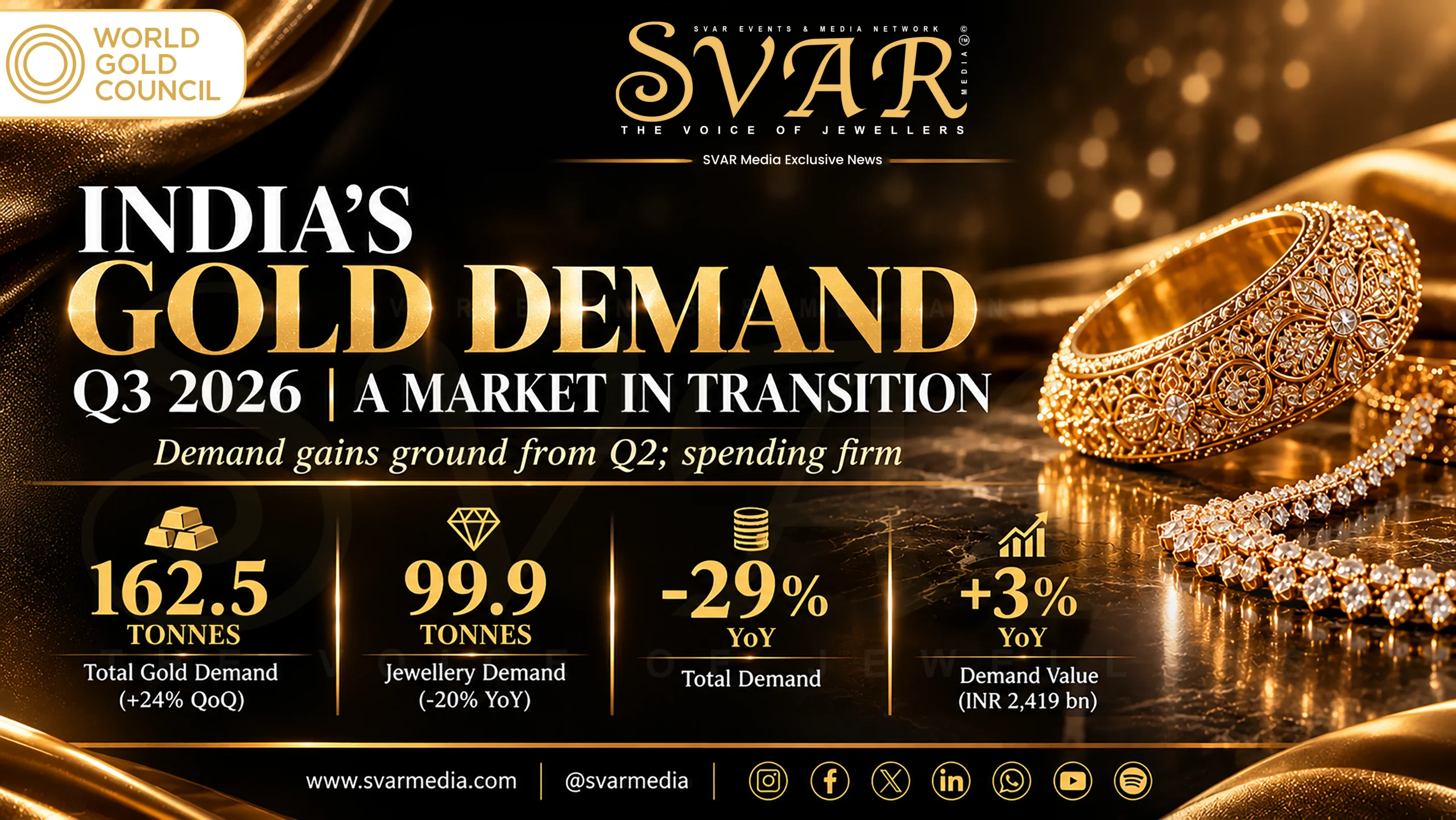
India’s gold market witnessed a sequential recovery in the third quarter of 2026, with total gold demand rising 24% quarter-on-quarter to 162 tonnes, supported by stronger jewellery purchases and continued interest in gold investments. However, demand remained 29% lower year-on-year as elevated domestic gold prices continued to affect affordability. According to the World Gold Council’s Gold Demand Trends: India Focus – Q3 2026, published in November 2026, the market also experienced significant changes in gold supply channels, with official bullion imports declining sharply, unofficial inflows increasing and recycling remaining relatively subdued. Despite lower purchasing volumes, the overall value of gold demand continued to rise, highlighting the growing financial commitment of Indian consumers and investors towards gold.
Quick Summary
- India’s total gold demand increased 24% quarter-on-quarter to 162.5 tonnes in Q3 2026, but remained 29% lower year-on-year.
- Total gold demand value increased 3% year-on-year to INR 2,419 billion (US$25.3 billion).
- Jewellery demand rose 33% quarter-on-quarter to approximately 100 tonnes, supported by festive and wedding purchases.
- Bar and coin demand increased 9% quarter-on-quarter to 55 tonnes but declined 40% year-on-year.
- Gold ETF demand increased to 5.3 tonnes from 3.6 tonnes in Q2 2026.
- Gross digital gold purchases reached 4.9 tonnes in Q3, while nine-month purchases increased 76% to 16.3 tonnes.
- Official bullion imports declined 70% year-on-year to 64 tonnes, while unofficial inflows increased to approximately 50 tonnes.
- Recycled gold supply remained relatively muted at 19 tonnes.
- Consumer intentions to increase jewellery purchases over the next three months rose from 20% to 29%.
- The World Gold Council expects festive and wedding demand to support Q4 2026, although high prices and rural economic weakness may constrain volumes.
1. India’s Gold Demand Strengthens Sequentially Despite High Prices
Quarterly Demand Shows Signs of Recovery
India’s gold market showed signs of recovery in Q3 2026 following the subdued performance recorded in the second quarter. Demand strengthened across all major segments, although the degree of improvement varied. Seasonal jewellery buying played a significant role in supporting the recovery, while investment demand also improved from the previous quarter.
Total Gold Demand Increases
Total gold demand increased 24% quarter-on-quarter to 162.5 tonnes. However, the market continued to face considerable pressure from elevated domestic gold prices, which remained significantly higher than the previous year. Consequently, total demand was 29% lower compared with Q3 2025.
Spending Remains Stronger Than Purchasing Volumes
The divergence between gold demand volumes and spending remained one of the most important features of the Indian market during the quarter. Although consumers purchased fewer tonnes of gold, the overall value of their purchases increased.
In Q3 2026, the value of India’s total gold demand reached INR 2,419 billion (US$25.3 billion), representing a 3% year-on-year increase. This indicates that consumers and investors continued allocating substantial amounts towards gold despite purchasing lower quantities because of elevated prices.
Nine-Month Demand and Value Comparison
The same trend was visible during the first nine months of 2026. India’s total gold demand declined 12% year-on-year to 443.9 tonnes, compared with 506.4 tonnes during the corresponding period of 2025. However, the value of demand increased 38% to INR 6,667.2 billion (US$71 billion), compared with INR 4,816.5 billion (US$55.6 billion) in the previous year.
This contrasting movement between volume and value demonstrates how rising gold prices have influenced purchasing behaviour, allowing overall expenditure to increase even as the quantity of gold purchased declined.
2. Domestic Gold Prices Remain Significantly Higher
International Gold Prices Ease From Their Peak
Gold prices continued to influence India’s demand patterns throughout Q3 2026. Although international gold prices eased from their January peak, domestic prices remained considerably higher than the previous year.
During the quarter, the international gold price averaged US$4,262 per ounce, declining 5% quarter-on-quarter while remaining 23% higher year-on-year.
Domestic Gold Prices Remain Elevated
Domestic gold prices followed a similar quarterly direction but remained significantly elevated annually. The average domestic gold price stood at INR 148,891 per 10 grams, declining 1% quarter-on-quarter while increasing 45% year-on-year.
The report attributes the stronger domestic price levels partly to the weakness of the Indian rupee and the higher import duty.
Domestic Gold Trades at a Discount to Import Parity
An important development during the quarter was the discount in domestic gold prices relative to import parity. This discount was attributed to increased unofficial gold inflows following the import duty increase, alongside the availability of old gold in the market.
The average discount reached US$43 per ounce in Q3 2026, marking the highest quarterly level on record.
The difference between international and domestic pricing, combined with higher import duties and currency movements, played an important role in shaping India’s gold supply and demand dynamics.
3. Jewellery Demand Recovers as Seasonal Buying Strengthens
Jewellery Demand Records Sequential Growth
Jewellery demand was one of the major contributors to India’s sequential gold demand recovery in Q3 2026.
Following a subdued second quarter, jewellery demand increased 33% quarter-on-quarter to approximately 100 tonnes. The improvement was supported by softer gold prices towards the end of the quarter, which encouraged consumers to proceed with purchases that had previously been deferred.
Festive and Wedding Purchases Support Demand
Wedding and festive purchases also contributed to the improvement, particularly in South India, where important festivals took place during August.
Onam and Varalakshmi were among the occasions that supported jewellery buying during the quarter.
High Prices and Festival Timing Affect Year-on-Year Demand
Despite the sequential recovery, jewellery demand remained 20% lower year-on-year. Elevated gold prices continued to affect affordability, while the timing of festivals also influenced the comparison.
Festivals that had supported jewellery purchases during Q3 2025 fell within the October–December quarter in 2026, shifting a portion of seasonal demand into the final quarter of the year.
Jewellery Spending Increases Despite Lower Volumes
The difference between jewellery demand volumes and spending continued to be significant.
Although jewellery demand declined year-on-year in terms of tonnage, its overall value increased. Q3 2026 jewellery demand value rose 16% year-on-year to INR 1,487 billion (US$16 billion), while increasing 31% quarter-on-quarter.
Revenue growth reported by listed jewellery companies during July–September also indicated that value growth continued to outperform volume growth.
Nine-Month Jewellery Spending Records Growth
During the first nine months of 2026, India’s jewellery demand declined 18% year-on-year to 241.1 tonnes. However, jewellery spending increased 29% to INR 3,618.3 billion (US$38.4 billion).
According to the report, the increase in jewellery demand value was entirely price-led, meaning consumers spent more despite purchasing less gold.
India Retains Its Position as the World’s Largest Jewellery Market
Despite the decline in jewellery volumes, India continued to maintain its position as the world’s largest jewellery market.
India accounted for 32% of global jewellery consumption in Q3 2026 and represented 27% of global jewellery consumption during the first nine months of the year.
This highlights the continued importance of India in the global gold jewellery market, even as elevated prices influence the quantity of gold purchased by consumers.
4. Investment Demand Moderates but Remains Resilient
Investment Demand Normalises From Earlier Highs
India’s gold investment demand moderated during Q3 2026 compared with the exceptionally strong levels recorded in the second half of 2025 and the first quarter of 2026. The moderation followed a period of strong investment activity as earlier gold price momentum began to fade.
Nevertheless, investment demand improved sequentially, increasing 12% quarter-on-quarter to approximately 60 tonnes. This indicated that investor interest in gold remained intact despite the moderation in price momentum.
Investment Share of Net Demand Declines
Another important development was the changing balance between jewellery and investment demand.
During Q1 2026, investment demand had overtaken jewellery demand, accounting for approximately 69% of net gold demand. By Q3 2026, this proportion had declined to around 42%, reflecting the recovery in jewellery purchases and the normalisation of investment activity.
Investment Demand Shows Greater Resilience
Despite the moderation, investment demand remained relatively resilient compared with jewellery demand.
During the first nine months of 2026, investment demand declined just 4% year-on-year, compared with an 18% decline in jewellery demand. This suggests that investment buying was comparatively less affected by elevated gold prices.
Bar and Coin Demand Remains the Largest Investment Channel
Gold bars and coins continued to represent India’s largest investment channel during Q3 2026.
Demand for bars and coins increased 9% quarter-on-quarter to 55 tonnes. However, it declined 40% year-on-year, partly reflecting the exceptionally strong base recorded in the previous year and some normalisation in investor purchases as gold price momentum eased.
Higher Import Duty Influences Physical Gold Investment
The report also highlights the impact of the nine-percentage-point increase in India’s gold import duty in May 2026.
According to the World Gold Council’s econometric models, bar and coin demand is relatively more sensitive to changes in import duties and income levels. Higher duties and restrictions tend to weigh on demand for these investment products.
India Remains the World’s Second-Largest Bar and Coin Market
Despite the year-on-year decline, India maintained its position as the world’s second-largest bar and coin market after China, accounting for approximately 21% of global bar and coin demand in Q3 2026.
India’s position as the second-largest global market for gold bars and coins highlights the continued importance of physical gold investments among Indian consumers.
Although demand moderated from the exceptionally high levels of the previous year, the market continued to account for a significant share of global physical gold investment.
The sequential improvement in Q3 also suggests that investor interest remained present despite the higher cost of purchasing gold and the impact of increased import duties.
5. Gold ETFs Attract Higher Investment
ETF Demand Increases in Q3
Gold exchange-traded funds (ETFs) continued to attract investment in India during Q3 2026.
ETF demand increased to 5.3 tonnes from 3.6 tonnes in Q2 2026, representing a 46% quarter-on-quarter increase. The improvement also lifted total gold ETF holdings to approximately 124 tonnes.
The continued inflows, despite the moderation in gold price momentum, indicated sustained investor interest in gold through financial investment channels.
Temporary Suspension of Fresh Gold FoF Subscriptions
The report also highlights an important development involving mutual fund houses and gold Fund of Funds (FoFs).
In mid-October 2026, mutual fund houses temporarily suspended fresh subscriptions to gold FoFs. However, existing systematic investment plans (SIPs) and direct investments in gold ETFs remained unaffected.
Gold FoFs accounted for assets under management equivalent to approximately one-third of gold ETF AUM.
The World Gold Council notes that this development will need to be monitored, although its impact on overall ETF flows is likely to remain contained because existing FoF SIPs and direct gold ETF investments continued.
This development is important for understanding the changing investment environment surrounding gold in India, particularly as investors increasingly use different financial products to gain exposure to the metal.
6. Digital Gold Continues to Expand as an Investment Option
Investment Extends Beyond Traditional Gold Products
Investment in gold is increasingly extending beyond traditional physical products such as bars and coins and financial products such as ETFs.
Digital gold continued to demonstrate growth during Q3 2026, reflecting the appeal of accessibility, convenience and relatively low minimum investment amounts.
Digital Gold Purchases Remain Strong
Gross digital gold purchases were estimated at 4.9 tonnes during the quarter. This was broadly stable compared with Q2 2026, when purchases stood at 4.8 tonnes, but represented an increase from 3.4 tonnes in Q3 2025.
The growth becomes even more significant when viewed over the first nine months of 2026.
Gross digital gold purchases increased 76% year-on-year to 16.3 tonnes, compared with 9.2 tonnes during the corresponding period of 2025.
Accessibility and Convenience Support Digital Gold
The report identifies accessibility, convenience and low minimum investment amounts as important factors supporting the appeal of digital gold.
The growth in digital gold purchases indicates that Indian investors are increasingly exploring different ways to participate in the gold market beyond conventional physical purchases.
However, the consumer sentiment survey discussed later in the report also shows that intended digital gold purchases declined between its two survey waves, highlighting that actual purchase trends and future buying intentions do not necessarily move in the same direction.
7. RBI Gold Purchases Remain Muted
RBI Gold Reserves Remain Broadly Unchanged
The Reserve Bank of India’s (RBI) gold purchases remained relatively subdued during the first nine months of 2026.
India’s official gold reserves remained broadly unchanged at approximately 880.5 tonnes as of the end of Q3 2026.
RBI Purchases Decline Significantly
The RBI purchased just 0.3 tonnes of gold during the first nine months of 2026. This was significantly lower than the 4 tonnes purchased during the corresponding period of 2025 and the 50 tonnes purchased during the first nine months of 2024.
Gold’s Share in Foreign Reserves Declines
Another notable development was the declining share of gold in India’s total foreign exchange reserves.
Gold’s share of total reserves decreased from 19% in January 2026 to 14.5% at the end of Q3 2026.
Shift From Active Accumulation Towards Maintaining Holdings
According to the World Gold Council, this indicates a shift from active reserve accumulation towards maintaining existing gold holdings.
Changes in gold’s share of total reserves also reflect valuation movements and changes in the broader reserve portfolio.
The relatively limited purchases during 2026 therefore represent a different approach compared with the more active accumulation observed in previous years.
8. India’s Gold Supply Declines as Import Patterns Change
Total Gold Supply Records a Sharp Decline
India’s gold supply experienced a significant decline during Q3 2026, accompanied by a noticeable shift in the sources of gold entering the domestic market.
Total gold supply was estimated at 136 tonnes during the quarter, representing a 43% year-on-year decline.
Net bullion imports, which include both official and unofficial imports, totalled 114 tonnes, accounting for approximately 84% of total gold supply.
Official Bullion Imports Fall 70%
However, official bullion imports, including doré, declined sharply to 64 tonnes, falling 70% year-on-year.
The report identifies several factors behind the decline in official imports:
- Softer physical gold demand.
- Inventory adjustments within the market.
- Imports potentially deferred because key festivals fell in October 2026, compared with September 2025.
- The impact of higher gold import duties.
The shift in the festive calendar was particularly relevant because it affected the timing of inventory requirements and gold purchases by market participants.
Higher Import Duty Encourages Unofficial Gold Inflows
One of the most significant developments in India’s gold supply market during Q3 2026 was the increase in unofficial gold inflows.
In May 2026, India’s gold import duty was increased to 15%, significantly changing the economics of official gold imports.
The higher duty increased the cost of importing gold through official channels. According to the World Gold Council, this created greater incentives for gold to enter India through unofficial channels, consistent with historical experience following increases in import duties.
Unofficial gold inflows were estimated to have increased to approximately 50 tonnes in Q3 2026.
This represented a substantial increase compared with just 3 tonnes in Q3 2025, when the import duty stood at 6%.
The increase in unofficial inflows also contributed to domestic gold prices trading at a discount to import parity during the quarter.
The report highlights that the combination of higher import duties, unofficial inflows and the availability of old gold significantly influenced India’s gold supply dynamics.
9. Gold Recycling Remains Muted Despite Higher Prices
Domestic Mine Production and Recycling Contribute to Supply
Gold recycling remained relatively subdued during Q3 2026, even though domestic gold prices were approximately 45% higher than a year earlier.
Domestic mine production contributed 3 tonnes to India’s gold supply during the quarter.
Recycled gold, defined in the report as old gold sold for cash or liquidated, accounted for 19 tonnes, representing approximately 14% of total gold supply.
Recycling Declines Despite Elevated Gold Prices
Recycled gold supply declined 12% year-on-year and remained broadly stable quarter-on-quarter.
The relatively limited response from recycling was notable because higher gold prices would generally be expected to encourage some gold holders to sell their existing holdings.
Gold Holders Remain Reluctant to Liquidate
However, the report suggests that gold holders remained reluctant to liquidate their assets despite the significant increase in domestic prices.
Instead, many appeared to prefer monetising their holdings through other channels.
The World Gold Council notes that this behaviour could indicate expectations of further price increases.
It is also important to distinguish between recycled gold and gold exchanged for other gold products. The report’s recycling figures include gold sold for cash or liquidated and exclude gold traded in or exchanged for other gold products.
The muted recycling response therefore provides an important insight into consumer behaviour and the availability of old gold in the Indian market.
10. Indian Consumers Show Stronger Interest in Gold Jewellery
World Gold Council–Kantar Consumer Survey
The World Gold Council, in collaboration with Kantar, conducted a multi-wave consumer survey to understand changing consumer sentiment and gold jewellery purchasing behaviour in India.
The survey examines how economic conditions, gold prices and affordability influence consumer decisions.
Wave 2 covered 1,957 consumers across 12 metropolitan and Tier I cities between 4 and 18 September 2026.
The first wave of the survey was conducted between 22 May and 3 June 2026.
Household Sentiment Shows Tentative Improvement
The second wave identified a tentative improvement in household sentiment regarding the overall economic outlook and personal financial situations.
It also indicated greater resilience in gold jewellery buying behaviour, with jewellery purchasing intentions strengthening despite elevated gold prices.
More Consumers Intend to Increase Jewellery Purchases
One of the most important findings from the second survey wave was the improvement in consumers’ intentions to increase gold jewellery purchases over the following three months.
The proportion of consumers expecting to increase their purchases rose from 20% in Wave 1 to 29% in Wave 2, representing an increase of 9 percentage points.
At the same time, the proportion expecting to reduce gold jewellery purchases declined from 51% to 40%, a reduction of 11 percentage points.
These changes indicate a more positive outlook for jewellery buying, although affordability and gold prices continued to influence purchase decisions.
The survey also found that consideration of buying gold jewellery over the next year increased from 73% to 76%.
Similarly, the proportion of consumers considering gold coin purchases over the next year increased from 35% to 40%.
However, intended purchases of digital gold moved in the opposite direction, declining from 38% to 34%.
Weddings and Festivals Become More Important Purchase Occasions
The survey highlights a growing concentration of gold jewellery buying around culturally important occasions.
Weddings accounted for 25% of respondents’ expected next jewellery purchases in Wave 2, compared with 22% in Wave 1.
Similarly, festivals and auspicious occasions increased their share from 16% to 21%.
These findings indicate that cultural and traditional occasions continue to play a significant role in determining when Indian consumers purchase gold jewellery.
The survey also recorded a decline in investment-led jewellery buying, with the proportion falling from 19% to 15%.
This suggests that jewellery purchases are becoming more closely associated with personal, cultural and occasion-based requirements rather than being driven primarily by investment considerations.
Consumers Become More Selective About Purchase Timing
The survey also indicates that consumers are increasingly adjusting the timing of their gold jewellery purchases.
The proportion of respondents intending to restrict their purchases to festivals, auspicious periods or promotional offers increased from 33% in Wave 1 to 39% in Wave 2.
Meanwhile, the proportion expecting to postpone purchases declined from 28% to 24%.
This suggests that although high gold prices continue to influence affordability, consumers are showing a stronger willingness to make purchases around specific occasions and favourable buying opportunities.
Consumers Adjust Purity and Financing Preferences
Another important finding concerns how consumers are adapting their purchasing behaviour to manage higher gold prices.
Among respondents expecting to change or maintain their purchasing behaviour, 77% indicated that they would trade down on purity or carat.
This was higher than the 72% recorded in Wave 1, representing an increase of 5 percentage points.
The survey also found an increase in consumers considering the exchange of old jewellery to finance new purchases.
The proportion considering old-gold exchange increased from 70% in Wave 1 to 76% in Wave 2.
This highlights the growing importance of old-gold exchange as a way for consumers to manage the cost of purchasing new jewellery.
Interest in EMI options and regular gold-savings schemes remained broadly stable.
Expectations of Further Gold Price Increases Moderate
Consumer expectations regarding future gold prices also changed between the two survey waves.
The proportion of respondents expecting gold prices to increase over the following three months declined from 69% in Wave 1 to 61% in Wave 2.
This represents a reduction of 8 percentage points.
Although a majority of surveyed consumers continued to expect higher gold prices, the declining proportion suggests that expectations of further price increases had softened.
The findings demonstrate that consumers are responding to the high-price environment through changes in purchasing timing, product preferences, purity considerations and financing methods.
11. Q4 2026 Outlook: Festive and Wedding Demand Expected to Support the Market
Seasonal Buying Expected to Support Q4 Demand
The World Gold Council expects seasonal buying to provide support to India’s gold demand during Q4 2026, particularly as the country enters the peak festive and wedding season.
Retailer restocking and increasing customer footfall point towards stronger jewellery demand during the final quarter of the year.
The timing of major festivals and weddings is expected to play an important role in supporting jewellery purchases, particularly because several occasions that fell in Q3 last year are taking place in the October–December period this year.
Softer gold prices could also encourage consumers to proceed with purchases that were previously postponed due to affordability concerns.
Elevated Gold Prices Continue to Challenge Jewellery Demand
Despite the improvement in consumer sentiment and seasonal buying expectations, elevated gold prices are likely to remain a significant constraint on jewellery volumes.
The substantial increase in domestic gold prices compared with the previous year continues to affect the quantity of gold consumers can afford to purchase.
Consumers may therefore continue adjusting their buying behaviour by choosing lower-purity products, exchanging old jewellery or restricting purchases to important occasions and promotional periods.
Rural Economic Conditions May Influence Demand
The World Gold Council also highlights weakness in the rural economy following a poor monsoon as a factor that could temper India’s overall gold demand during Q4.
Rural demand is an important part of the Indian gold market, and weaker economic conditions could affect purchasing capacity during the festive and wedding season.
Consequently, while seasonal demand is expected to provide support, the extent of the recovery will depend on affordability and household financial conditions.
Investment Demand Expected to Remain Positive
Investment demand is expected to remain positive during Q4 2026.
However, the World Gold Council expects investment activity to remain sensitive to gold price momentum.
The moderation in investment demand during Q3, particularly in bars and coins, indicates that investors are responding to changing price conditions.
The continued interest in gold ETFs and digital gold demonstrates that investment demand is also spread across different purchasing channels.
Overall, the Q4 outlook points towards seasonal support for India’s gold market, with jewellery demand benefiting from festive and wedding purchases, while elevated prices and rural economic weakness may limit the scale of the recovery.
12. Key Statistical Highlights: India’s Gold Market in Q3 2026
The following figures summarise the major developments in India’s gold market during Q3 2026 and the first nine months of the year.
A. Gold Demand by Segment
| Segment | Q3 2026 Demand | Q/Q Change | Y/Y Change |
|---|---|---|---|
| Jewellery | 99.9 tonnes | +33% | -20% |
| Bar and Coin | 55.0 tonnes | +9% | -40% |
| Gold ETFs | 5.3 tonnes | +46% | -50% |
| Industrial | 2.3 tonnes | +22% | -7% |
| Total Demand | 162.5 tonnes | +24% | -29% |
B. Value of Gold Demand
| Segment | Q3 2026 Value (INR billion) | Y/Y Change |
|---|---|---|
| Jewellery | 1,487.0 | +16% |
| Bar and Coin | 818.9 | -13% |
| Gold ETFs | 78.9 | -28% |
| Industrial | 34.2 | +35% |
| Total Demand | 2,419.0 | +3% |
C. First Nine Months of 2026
| Indicator | 9M 2026 | Y/Y Change |
|---|---|---|
| Total gold demand | 443.9 tonnes | -12% |
| Jewellery demand | 241.1 tonnes | -18% |
| Bar and coin demand | 167.5 tonnes | -9% |
| Gold ETF demand | 28.8 tonnes | +47% |
| Industrial demand | 6.5 tonnes | -7% |
| Total demand value | INR 6,667.2 billion | +38% |
| Jewellery demand value | INR 3,618.3 billion | +29% |
| Bar and coin demand value | INR 2,517.7 billion | +43% |
| Gold ETF demand value | INR 434.0 billion | +133% |
| Digital gold purchases | 16.3 tonnes | +76% |
D. Gold Prices
| Indicator | Q3 2026 Average | Y/Y Change |
|---|---|---|
| International gold price (LBMA PM) | US$4,262/oz | +23% |
| Domestic MCX spot gold price | INR 148,891/10g | +45% |
E. Gold Supply
| Indicator | Q3 2026 |
|---|---|
| Total gold supply | 136 tonnes |
| Net bullion imports | 114 tonnes |
| Official bullion imports, including doré | 64 tonnes |
| Estimated unofficial inflows | Approximately 50 tonnes |
| Domestic mine production | 3 tonnes |
| Recycled gold | 19 tonnes |
Note: Figures are based on the World Gold Council report. Percentage changes refer to the comparison period specified in the report. Values are subject to rounding.
13. What the Consumer Sentiment Survey Reveals
The comparison between the two survey waves provides a clearer understanding of how Indian consumers are responding to elevated gold prices.
| Consumer Behaviour | Wave 1 | Wave 2 | Change |
|---|---|---|---|
| Intend to increase jewellery buying in next 3 months | 20% | 29% | +9 ppt |
| Intend to reduce jewellery purchases in next 3 months | 51% | 40% | -11 ppt |
| Considering jewellery purchases over the next year | 73% | 76% | +3 ppt |
| Investment-led jewellery buying | 19% | 15% | -4 ppt |
| Intend to buy during festivals, auspicious days or offers | 33% | 39% | +6 ppt |
| Consider old-gold exchange | 70% | 76% | +6 ppt |
| Will trade down on purity | 72% | 77% | +5 ppt |
| Expect higher gold prices | 69% | 61% | -8 ppt |
Source: World Gold Council–Kantar Consumer Sentiment Survey, Wave 1 and Wave 2.
14. Overall Assessment: A Gold Market Defined by Higher Spending and Changing Buying Behaviour
Quarterly Recovery Amid Affordability Challenges
The World Gold Council’s Q3 2026 report presents an Indian gold market experiencing a recovery in quarterly demand while continuing to face affordability challenges arising from elevated prices.
The increase in total demand to 162.5 tonnes reflects an improvement from Q2, with jewellery purchases benefiting from seasonal buying, wedding demand and softer prices towards the end of the quarter.
However, the year-on-year decline in demand highlights the extent to which higher gold prices continue to influence purchasing volumes.
Higher Spending Despite Lower Gold Consumption
One of the most significant trends is the widening gap between gold consumption by volume and expenditure by value. Although consumers purchased less gold during the first nine months of 2026, their total spending increased substantially.
Investment Channels Continue to Evolve
The investment market is also evolving. Bars and coins remain the largest investment channel, while ETFs and digital gold continue to provide additional ways for investors to participate in the gold market.
Supply Dynamics Undergo Significant Changes
At the same time, India’s gold supply structure has undergone significant changes. Higher import duties have reduced official imports and increased the incentive for unofficial inflows, while recycling has remained relatively muted despite higher domestic prices.
Consumer Behaviour Reflects Changing Purchase Strategies
The consumer sentiment survey provides another important dimension to the market. It indicates that consumers continue to consider gold jewellery purchases, but are becoming more selective about when and how they buy. Weddings, festivals and auspicious occasions are gaining importance, while old-gold exchange and adjustments in purity are emerging as ways to manage higher purchase costs.
Q4 Outlook Remains Dependent on Seasonal Demand and Affordability
Looking ahead, the festive and wedding season is expected to support demand in Q4 2026. Nevertheless, the outlook will remain influenced by domestic gold prices, rural economic conditions and the momentum of investment demand.
India’s gold market, therefore, continues to demonstrate strong underlying interest in the precious metal, even as consumers and investors adapt their purchasing strategies to a higher-price environment.
FAQs
How much gold did India consume in Q3 2026?
India’s total gold demand reached 162.5 tonnes in Q3 2026, increasing 24% quarter-on-quarter but declining 29% year-on-year.
How much did India’s gold demand increase in value?
The value of India’s total gold demand increased 3% year-on-year to INR 2,419 billion (US$25.3 billion) in Q3 2026.
What was India’s jewellery demand in Q3 2026?
India’s jewellery demand reached 99.9 tonnes in Q3 2026, increasing 33% quarter-on-quarter but declining 20% year-on-year.
Why did jewellery demand decline year-on-year?
Elevated domestic gold prices continued to affect affordability. The shift in the festive calendar also influenced the comparison, as festivals that supported Q3 2025 demand fell in the October–December period in 2026.
What was India’s gold investment demand in Q3 2026?
Investment demand improved 12% quarter-on-quarter to approximately 60 tonnes. Bar and coin demand reached 55 tonnes, while ETF demand increased to 5.3 tonnes.
How much gold did Indian gold ETFs attract in Q3 2026?
Gold ETF demand increased to 5.3 tonnes in Q3 2026 from 3.6 tonnes in Q2 2026, taking total holdings to approximately 124 tonnes.
How much digital gold did India purchase in the first nine months of 2026?
Gross digital gold purchases reached 16.3 tonnes during the first nine months of 2026, increasing 76% year-on-year from 9.2 tonnes.
How much gold did the RBI purchase in the first nine months of 2026?
The RBI purchased just 0.3 tonnes of gold during the first nine months of 2026, compared with 4 tonnes during the same period in 2025.
Why did unofficial gold imports increase in India?
The increase in import duty to 15% in May 2026 raised the cost of official gold imports and increased the incentive for unofficial inflows. These inflows were estimated at approximately 50 tonnes in Q3 2026, compared with 3 tonnes in Q3 2025.
How much recycled gold entered India’s supply in Q3 2026?
Recycled gold contributed 19 tonnes, accounting for approximately 14% of total gold supply. Recycled supply declined 12% year-on-year.
What did the World Gold Council’s consumer survey reveal?
The survey found improving jewellery purchasing intentions. Consumers intending to increase jewellery purchases over the following three months rose from 20% to 29%, while those considering old-gold exchange increased from 70% to 76%.
What is the outlook for India’s gold demand in Q4 2026?
The World Gold Council expects festive and wedding purchases to support Q4 demand. However, elevated gold prices and weakness in the rural economy following a poor monsoon may constrain jewellery volumes. Investment demand is expected to remain positive but sensitive to price momentum.
Source: SVAR Media Network
About SVAR Media Network – India’s Best Source for Jewellery News, Magazines, Newsletters and Media
SVAR Media Network is India’s No. 1 Destination for Jewellery News, setting the gold standard in timely, trusted, & trend-driven coverage across the Gems & Jewellery industry. As the Most Followed Jewellery Magazine & Media House in India, SVAR delivers Daily Jewellery News India Updates, market insights, & global developments through its platforms like Jewellery Magazine, Newsletters, AI Powered News Bulletins, Website, Social Media, Podcasts, & much more.
Recognized as Asia’s one of the Best Media in Jewellery & one of the World’s Best Jewellery Media, SVAR Media Network sets Unparalleled Standards in the Gems & Jewellery industry. SVAR is the Most Trusted & Widely Read Voice in the Gems & Jewellery Community.
Renowned as India’s Best Jewellery Magazine & Leading Jewellery Media, SVAR blends legacy with cutting-edge innovation by delivering:
- Best in class Jewellery Magazine for the Gems & Jewellery Industry & Jewellery Enthusiasts
- Real-time AI-Powered Jewellery News via SVARA AI, the World’s First AI Anchor in Fashion, Gems & Jewellery Industry
- India’s One of the First Gems & Jewellery Podcasts
- Digital Jewellery Newsletters for professionals and enthusiasts
- ISO 9001:2015 Certification, the first in the jewellery-media sector, proving our commitment to excellence
- Asia’s First & World’s Second Meta Verified Jewellery Media Brand

Ranked #1 among the Top 5 Gems & Jewellery News Websites, Top 10 Jewellery Magazines in India, & Most Influential Jewellery Media Brands, SVAR Media Network is your Trusted Source for Accurate, Fast, & Future-Focused Jewellery News.
SVAR Media Network is India’s No 1 Digital Media in Jewellery Industry & continues to be the Leading Jewellery Magazine & a Global Leader in Jewellery Media. SVAR Media Network offers a diverse range of services, including: Monthly Magazines, Digital Newsletters, Al-Driven News Bulletins, Social Media Promotions, Website Blogs & Articles, WhatsApp Updates, Podcasts & more…
Whether you seek updates on New Launches, Trade Shows, Celebrity Campaigns, Trends or Market Movements, SVAR is the Authority in Jewellery News India & beyond.
Explore the World of Gems & Jewellery with SVAR Media Network — Your Best Source for Trusted, Trend-Setting Jewellery News & Media, Updates, Podcasts & more…