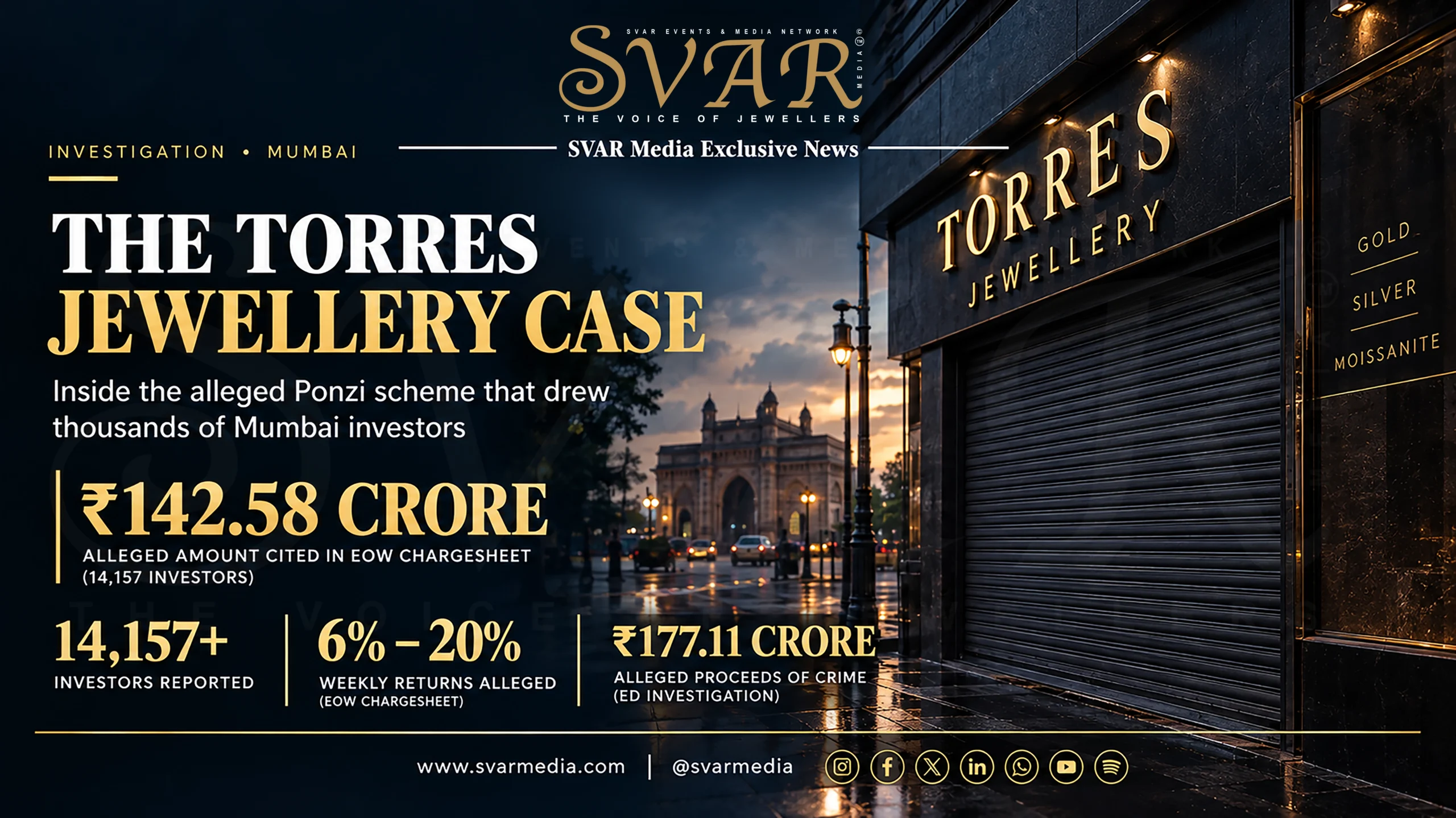
The Torres Jewellery case became a major financial fraud investigation after investors reported that promised payments had stopped in early January 2025. The company, Platinum Hern Pvt. Ltd., operated under the Torres Jewellery brand and allegedly attracted investors through schemes linked to gold, silver and synthetic moissanite stones. The investigation examined promises of unusually high returns, referral incentives, promotional rewards and the valuation of jewellery products. In March 2025, the Mumbai Police Economic Offences Wing (EOW) filed a 27,147-page chargesheet, reporting alleged losses of ₹142.58 crore involving 14,157 investors. These figures represent allegations reported by investigators, not a final judicial determination.
Quick Summary
- Torres Jewellery became the subject of an investment fraud investigation involving Platinum Hern Pvt. Ltd.
- The EOW’s March 2025 chargesheet reported alleged losses of ₹142.58 crore involving 14,157 investors.
- According to reporting on the EOW chargesheet, investors were allegedly promised weekly returns of 6% to 20% for 52 weeks, depending on the investment plan.
- The ED separately reported weekly returns of 2% to 9% in its investigation.
- Reported incentives included referral rewards, jewellery discounts and lucky draws.
- The ED’s separate investigation reportedly alleged ₹177.11 crore in money laundering; this is not the same figure as the EOW’s reported investor losses.
- Investors reported payment disruptions in early January 2025.
- A court later permitted the sale of certain seized assets as part of the recovery process, but full repayment to investors should not be assumed.
How Torres Jewellery Turned Jewellery Purchases Into an Investment Pitch
According to the EOW investigation, Torres linked jewellery purchases with promises of recurring financial returns. The arrangement reportedly combined physical products with investment-linked benefits, presenting customers with the prospect of owning jewellery while receiving regular payouts.
The EOW chargesheet reportedly described weekly returns ranging from 6% to 20% for 52 weeks, depending on the investment plan. Separately, the Enforcement Directorate (ED) reported that investors were allegedly offered weekly returns ranging from 2% to 9%. These figures were reported in connection with different investigative accounts and should not be treated as identical offers.
Referral rewards, lucky draws and discounts reportedly added to the scheme’s appeal. The arrangement attracted scrutiny after investors reported payment disruptions and gathered outside Torres outlets seeking answers.
The central question is whether the business could legitimately generate sufficient income to fulfil its financial commitments. The presence of jewellery products, invoices and physical stores does not, by itself, establish that an investment arrangement is financially sustainable.
Sources: The Indian Express — EOW chargesheet | The Indian Express — ED investigation
1. The Jewellery Business That Became the Face of the Scheme
Torres built its investment proposition around purchases of gold, silver and moissanite jewellery. Rather than presenting the opportunity solely as a conventional financial investment, the business reportedly connected jewellery purchases with promised returns and promotional benefits.
Moissanite became a significant part of the investigation because the ED alleged that synthetic stones were marketed as high-value investments comparable to diamonds and sold at inflated prices.
These allegations raised questions about the relationship between the products’ actual market value and the returns promised to investors.
A physical product can have legitimate commercial value, but that value is separate from the financial sustainability of an investment scheme. The price of jewellery, its resale value and the income required to fund recurring payouts are different considerations.
For investors, the presence of a product or showroom should not replace independent verification of the investment terms and the source of the promised income.
2. Why Weekly Returns Became a Major Attraction
The level of returns allegedly promised to investors was one of the most significant aspects of the Torres case.
According to reporting on the EOW chargesheet, investors were offered weekly returns of 6% to 20% for 52 weeks, depending on their investment plan. The ED separately reported a range of 2% to 9% weekly in its investigation.
These figures must remain clearly attributed to their respective sources rather than being combined into a single return range.
The prospect of frequent payouts could appeal to people seeking regular income. However, unusually high returns make it especially important to understand how the money is generated.
Receiving an initial payment does not establish that an investment is legitimate or that the principal will be returned. Investors need to determine whether promised returns are supported by verifiable business earnings and whether those earnings can sustain the commitments over time.
Sources: The Indian Express — EOW chargesheet and investor returns | The Indian Express — ED investigation
3. Initial Payouts and the Appearance of Credibility
Early payments can influence how participants assess an investment opportunity. When someone receives a payment as promised, they may interpret the experience as evidence that the arrangement is reliable.
That confidence can lead investors to continue participating, commit additional funds or recommend the opportunity to friends, relatives and business associates.
Personal recommendations can carry considerable weight because prospective investors may trust people they know more than conventional advertising.
In an alleged Ponzi structure, early payouts may help sustain the appearance that the arrangement is working. However, payments received by some participants do not establish that the business generates sufficient legitimate income to meet all its obligations.
The Torres investigation highlights why investors should examine the source of promised returns rather than relying solely on payment histories or personal testimonials.
4. Referral Rewards Expanded the Reach of the Scheme
Referral incentives were reportedly part of the Torres investment proposition. Such rewards can encourage existing participants to introduce the opportunity to friends, relatives and professional contacts.
When people believe they have benefited from an arrangement, they may share their experiences with others. If referrals also generate financial rewards, recommending the scheme can become attractive in its own right.
However, the number of people recommending an investment does not establish its financial soundness. Nor does a referral reward prove that the underlying business generates sufficient profits to fund promised returns.
Investors should assess the business model independently instead of relying solely on personal recommendations, testimonials or the experiences of early participants.
5. Lucky Draws and Prizes Added to the Appeal
The EOW chargesheet reportedly described promotional lucky draws used to attract Torres customers.
According to reporting by The Indian Express, customers purchasing jewellery worth ₹20,000 or more were told they could receive coupons for weekly lucky draws. Reported prizes included a car, a television and a jewellery set.
The same report stated that investors committing more than ₹1 lakh were told they could qualify for a draw featuring a one-bedroom apartment.
These details were reported as part of the allegations described in the police investigation.
Promotional prizes can make an offer appear more attractive by introducing the possibility of benefits beyond the original purchase. However, a lucky draw does not establish that an investment is profitable, that its principal is protected or that promised returns can be sustained.
Source: The Indian Express — Lucky draws and the EOW chargesheet
6. Discounts and the Appeal of Larger Commitments
Discounts were also reported as part of the Torres proposition. Media reporting described an offer under which investors could receive a ₹10,000 pendant discount for every ₹1 lakh invested.
This specific offer should be understood as a reported promotional claim, not an independently verified valuation of the jewellery or a guarantee of financial benefit.
Discounts can influence how people evaluate a large commitment. A customer may consider the jewellery benefit an additional advantage alongside the promised investment returns.
However, a discount does not establish the market value of an item, guarantee its resale price or demonstrate that the business can generate sufficient income to fund recurring payouts.
Investors should assess the actual financial terms independently of the promotional incentives used to attract participation.
7. Questions Over Moissanite Pricing and Product Valuation
Moissanite featured prominently in the reported investment schemes. The ED alleged that synthetic moissanite stones were marketed as high-value investments comparable to diamonds and sold at inflated prices.
The agency’s investigation raised questions about how the stones were represented to customers and the relationship between their valuations and the returns allegedly promised.
Exact purchase prices, resale prices and supplier transaction totals should not be treated as established facts unless supported by a reliable report or an official investigative document. This article therefore does not present unverified stone-by-stone pricing figures as confirmed findings.
The broader issue is the importance of independently verifying the quality, market value and resale potential of products linked to an investment proposition.
A retail price printed on an invoice is not necessarily the amount an investor could recover by reselling the item. Similarly, a high product valuation does not automatically generate the cash flow needed to fund recurring returns.
Source: The Indian Express — ED investigation into Torres
8. Payment Disruptions Raised Questions About Sustainability
The situation escalated in late December 2024 and early January 2025, when investors reportedly experienced disruptions in the promised payments.
Reports on the investigation stated that investors gathered outside Torres outlets on January 6, 2025, seeking explanations after the expected payouts stopped.
The disruption raised immediate concerns among people who had committed money on the expectation of regular returns.
An investment arrangement promising frequent payouts must have a credible way to generate the income required to meet those commitments. If payments depend on continuing inflows from new participants rather than sustainable business earnings, the arrangement may become vulnerable when those inflows slow.
The reported payment disruptions became an important part of the investigation into the Torres case.
Source: The Indian Express — EOW chargesheet
9. Allegations of Cash Incentives and Unregulated Deposits
The EOW investigation examined how money was collected from investors and the regulatory status of the arrangement.
According to reporting on the chargesheet, investors were allegedly offered an additional 2% return for cash payments. The chargesheet reportedly stated that people interested in digital payments were discouraged with explanations involving internet connectivity or network problems.
The EOW also reportedly stated that Platinum Hern Pvt. Ltd. was not registered as a non-banking financial company (NBFC) and lacked the necessary authority to accept deposits in the manner described in the investigation.
These are investigative allegations and findings reported in the context of legal proceedings. They should not be presented as a final judicial determination.
The case highlights the importance of verifying a company’s legal status and whether it is authorised to offer the financial arrangement being promoted. A business’s physical presence or ordinary company registration does not automatically authorise it to accept deposits or operate every type of investment scheme.
Source: The Times of India — EOW allegations concerning cash payments
10. How an Alleged Ponzi Structure Can Depend on New Investor Money
A Ponzi scheme typically uses money received from newer participants to pay earlier participants, rather than generating sufficient legitimate earnings through the activity presented to investors.
Such an arrangement can appear successful for a period because some participants receive payments. Those payments may strengthen confidence, encourage reinvestment and attract additional participants.
The cycle can become vulnerable when incoming funds are no longer sufficient to meet the payments due.
In the Torres case, investigators examined the alleged arrangement as a Ponzi scheme. The reported combination of high return promises, referral incentives and subsequent payment disruptions formed part of the allegations.
The term describes the alleged nature of the scheme in the investigation and should not be treated as a substitute for a final judicial finding of guilt.
For investors, the essential question is whether the promised income comes from genuine, verifiable commercial activity and whether that activity can support the financial commitments being made.
11. Closed Outlets Added to Investor Concerns
As investors sought explanations and repayment, reports indicated that they encountered closed Torres outlets.
The closures added to uncertainty about the business and left investors seeking information about the status of their money.
A physical retail location can demonstrate that a business has a commercial presence, but it cannot independently prove that the business is financially sound or capable of meeting investment obligations.
A showroom, invoices, employees and branded products may create a familiar retail environment. However, financial due diligence remains necessary when an offer includes unusually high returns.
The Torres case illustrates why the appearance of a conventional jewellery business and the financial sustainability of an investment proposition must be evaluated separately.
12. Torres Case: Reported Investor Numbers and Financial Figures
The reported financial figures changed as the investigation progressed. These numbers relate to different stages of reporting and should not be treated as interchangeable.
The key reported figures include:
- Initial complaint: Early reporting described a complaint involving 66 investors and alleged losses of ₹13.48 crore.
- February 2025: Reports cited more than 10,000 investors and alleged losses of ₹117.63 crore.
- March 2025 EOW chargesheet: Mumbai Police reported alleged losses of ₹142.58 crore involving 14,157 investors. The chargesheet ran to 27,147 pages and named eight accused.
- Separate ED investigation: In May 2025, reporting on the ED chargesheet stated that the agency alleged ₹177.11 crore had been laundered in connection with the case.
The EOW’s ₹142.58 crore figure and the ED’s ₹177.11 crore figure refer to different investigative assessments. They should not be added together or presented as the same measure of investor losses.
The EOW also reported that its figure did not include fraud reported in three other FIRs registered in Mira Road, Thane and Navi Mumbai.
These figures are reported investigative amounts and allegations. They do not, by themselves, establish a final amount recoverable by investors or a final judicial determination of liability.
Sources: The Indian Express — EOW chargesheet | The Indian Express — ED’s ₹177.11 crore allegation
13. Legal Proceedings and Efforts to Recover Assets
The EOW filed its chargesheet in March 2025 against eight accused in connection with the alleged Torres investment fraud. The investigation involved allegations under applicable laws relating to cheating and unregulated deposit schemes.
The authorities also pursued assets connected to the case. In June 2025, media reports stated that a special court had permitted the sale of seized gold, silver and moissanite stones, with the proceeds to be deposited into a dedicated account as part of the recovery process.
Permission to sell seized assets does not mean investors have already received refunds or that all claimed losses will necessarily be recovered.
The amount ultimately recoverable depends on the assets available, the legal process and the outcome of the proceedings.
Source: The Times of India — Court allows sale of seized assets
14. What the Torres Jewellery Case Highlights for Investors
The Torres case brings together several issues that investors should consider when evaluating opportunities linked to retail products.
Physical retail presence: A showroom and tangible products do not guarantee financial security.
Unusually high returns: Promises of substantial returns at frequent intervals require a credible explanation of how the income is generated.
Referral incentives: Personal recommendations and rewards for bringing in new participants are not proof of an investment’s financial soundness.
Promotional prizes: Lucky draws and discounts should be assessed separately from the safety of the principal and the sustainability of returns.
Product valuation: Jewellery and gemstones should be independently assessed, particularly when product purchases are linked to investment promises.
Regulatory verification: Investors should check the legal status of the business and whether it is authorised to offer the financial arrangement being promoted.
None of these features, considered in isolation, proves that a business is fraudulent. The concern arises when extraordinary financial promises are made without a clear, verifiable explanation of how the obligations can be met.
The Torres investigation underscores the importance of examining the complete investment arrangement rather than relying on appearances, early payouts or personal endorsements.
Conclusion: The Investment Lesson From the Torres Jewellery Case
The Torres Jewellery case illustrates how an alleged investment scheme can be promoted through the familiar setting of a retail business. Jewellery products, physical outlets, weekly return promises, referral incentives and promotional prizes reportedly formed part of the proposition that attracted thousands of investors.
The central issue is not simply whether a company sells jewellery. It is whether the business can legitimately generate enough income to meet the financial commitments associated with its investment-linked offers.
The EOW reported alleged losses of ₹142.58 crore involving 14,157 investors in its March 2025 chargesheet. Separately, the ED’s investigation reportedly alleged ₹177.11 crore in money laundering connected with the case. These figures represent different investigative assessments and must be presented with their respective sources and context.
The reported legal proceedings and asset-recovery measures are important developments, but they should not be interpreted as confirmation that every investor will recover the full amount claimed.
For investors, the lesson is to look beyond appearances and advertised benefits. A physical store does not guarantee financial security, early payouts do not prove long-term sustainability, and recommendations from trusted acquaintances do not replace independent verification.
Before committing money to any investment opportunity, investors should ask a fundamental question: What genuine economic activity generates the promised return, and can that income be independently verified?
When an offer promises exceptionally high returns at frequent intervals, that question deserves particular scrutiny.important than the confidence created by a product, a showroom or a history of initial payments.
FAQs
What was the Torres Jewellery alleged Ponzi scheme?
The Torres Jewellery case involved an alleged investment arrangement linked to gold, silver and synthetic moissanite stones. Investigators said the scheme attracted participants through promises of high returns and promotional incentives.
How much return did Torres Jewellery allegedly promise investors?
Reporting on the EOW chargesheet stated that investors were allegedly promised weekly returns ranging from 6% to 20% for 52 weeks. The ED separately reported a range of 2% to 9% weekly.
How many investors were reportedly affected?
The EOW chargesheet reported 14,157 investors and alleged losses of ₹142.58 crore in the case covered by its investigation.
What was the amount associated with the ED investigation?
In May 2025, reporting on the ED chargesheet stated that the agency alleged ₹177.11 crore had been laundered in connection with the case. This is a separate investigative figure and should not be confused with the EOW’s reported investor losses.
Why was moissanite important to the Torres case?
Moissanite formed a significant part of the reported investment proposition. The ED alleged that synthetic stones were marketed as high-value investments comparable to diamonds and sold at inflated prices.
When did investors report payment problems?
Investors reportedly gathered outside Torres outlets in early January 2025 after expected payments stopped.
Have investors recovered their money?
Court proceedings have included permission to sell certain seized assets as part of the recovery process. This does not guarantee that every investor will recover the full amount claimed.
What warning signs did the Torres case highlight?
The case highlights the importance of scrutinising unusually high returns, verifying the source of promised income, checking regulatory authorisations and avoiding reliance on early payouts or referral recommendations as proof of financial security.
What is the main lesson for investors?
Investors should independently verify how an investment generates its promised returns. Physical stores, jewellery products, early payments and referral incentives do not guarantee that an investment is sustainable or that the principal will be returned.
Editorial and legal note: This article summarises allegations and investigative reporting from the sources cited. Allegations are not equivalent to a final finding of guilt. Financial figures refer to different investigations and reporting dates and should not be treated as interchangeable.
Source: SVAR Media Network
About SVAR Media Network – India’s Best Source for Jewellery News, Magazines, Newsletters and Media
SVAR Media Network is India’s No. 1 Destination for Jewellery News, setting the gold standard in timely, trusted, & trend-driven coverage across the Gems & Jewellery industry. As the Most Followed Jewellery Magazine & Media House in India, SVAR delivers Daily Jewellery News India Updates, market insights, & global developments through its platforms like Jewellery Magazine, Newsletters, AI Powered News Bulletins, Website, Social Media, Podcasts, & much more.
Recognized as Asia’s one of the Best Media in Jewellery & one of the World’s Best Jewellery Media, SVAR Media Network sets Unparalleled Standards in the Gems & Jewellery industry. SVAR is the Most Trusted & Widely Read Voice in the Gems & Jewellery Community.
Renowned as India’s Best Jewellery Magazine & Leading Jewellery Media, SVAR blends legacy with cutting-edge innovation by delivering:
- Best in class Jewellery Magazine for the Gems & Jewellery Industry & Jewellery Enthusiasts
- Real-time AI-Powered Jewellery News via SVARA AI, the World’s First AI Anchor in Fashion, Gems & Jewellery Industry
- India’s One of the First Gems & Jewellery Podcasts
- Digital Jewellery Newsletters for professionals and enthusiasts
- ISO 9001:2015 Certification, the first in the jewellery-media sector, proving our commitment to excellence
- Asia’s First & World’s Second Meta Verified Jewellery Media Brand

Ranked #1 among the Top 5 Gems & Jewellery News Websites, Top 10 Jewellery Magazines in India, & Most Influential Jewellery Media Brands, SVAR Media Network is your Trusted Source for Accurate, Fast, & Future-Focused Jewellery News.
SVAR Media Network is India’s No 1 Digital Media in Jewellery Industry & continues to be the Leading Jewellery Magazine & a Global Leader in Jewellery Media. SVAR Media Network offers a diverse range of services, including: Monthly Magazines, Digital Newsletters, Al-Driven News Bulletins, Social Media Promotions, Website Blogs & Articles, WhatsApp Updates, Podcasts & more…
Whether you seek updates on New Launches, Trade Shows, Celebrity Campaigns, Trends or Market Movements, SVAR is the Authority in Jewellery News India & beyond.
Explore the World of Gems & Jewellery with SVAR Media Network — Your Best Source for Trusted, Trend-Setting Jewellery News & Media, Updates, Podcasts & more…