
GSI Research Department: Deepa Srinivasa (Chief Gemologist); Dr. Ramchandra Patil, Ph.D. Physics (Research Specialist & Gemologist); Bharanidharan K, M.Sc., Mphil. Physics (Se nior Research Associate & Gemologist); Prathamesh , B.Sc. Physics (Junior Research Associate & Gemologist), Gemological Science International, Mumbai
The Usambara Effect: Challenging Color-Change Gemstone Understanding
For decades, the world of gemstones has been enamored with the enchanting color-changing abilities of certain stones, none more famous than the Alexandrite, with its dramatic shift from green in daylight to red under incandescent light. But there are phenomena which are not so known, like the Usambara Effect(UE) found in Tanzanian garnets, pushing the boundaries of what we know about color-change gems. A complex and nuanced optical behavior that could challenge our understanding of color change in gemstones, the UE remains relatively unknown, even among seasoned professionals.

Article Overview and Scope
In this article, we’ll explore the Usambara Effect, compare it to the more familiar dichromatism, pleochroism, and the Alexandrite effect, and explain how this particular case, studied through garnets submitted to the lab, could set the stage for a deeper understanding of gemstone optical properties.
The Usambara Effect vs. Dichromatism
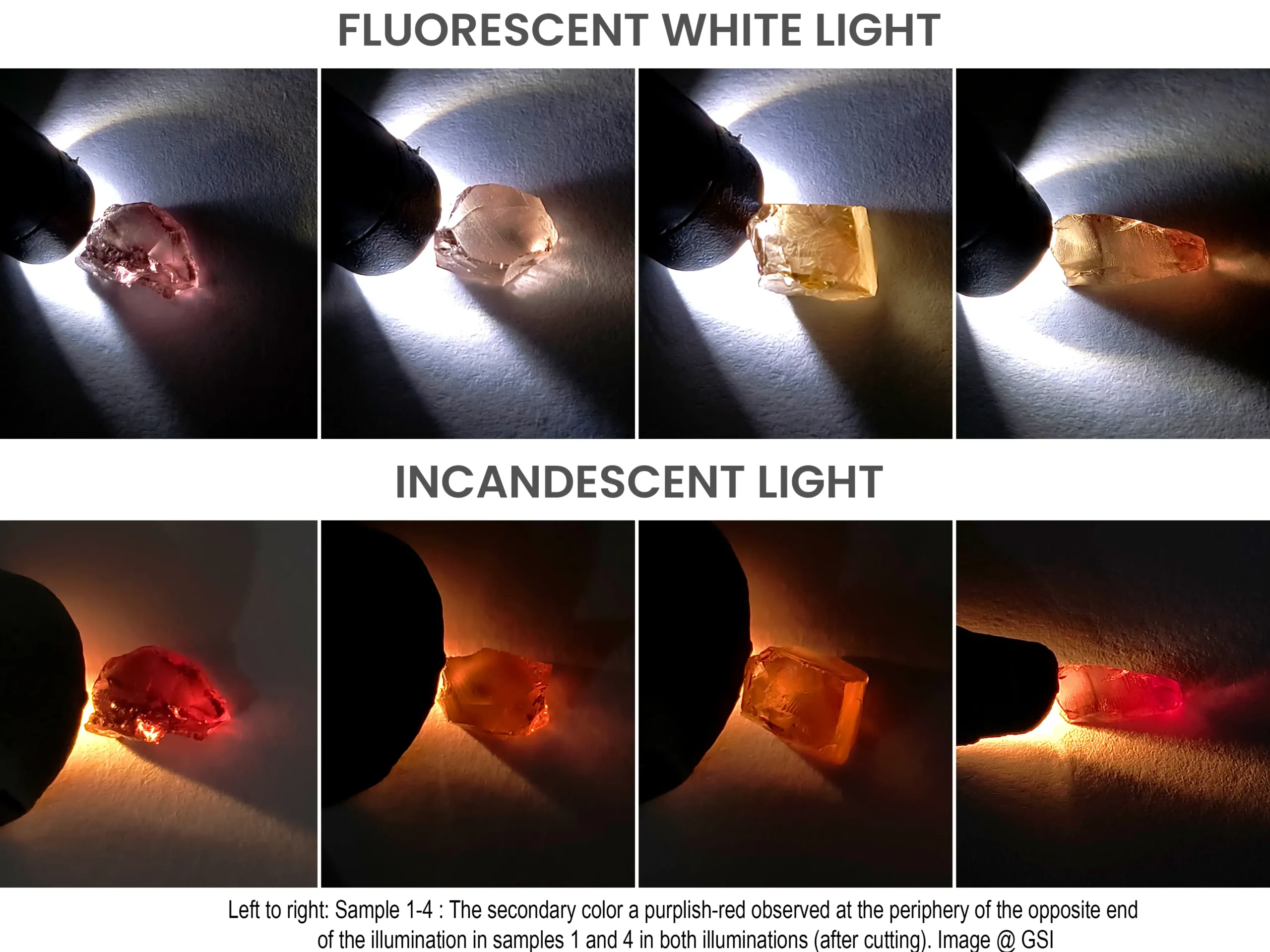
Before we dive into the specifics of the Usambara Effect, let’s clarify what it is and how it compares to other common optical effects in gemstones, starting with dichromatism. Dichromatism is the phenomenon where a gemstone displays two distinct colors depending on the light source, such as blue-green in daylight and red or purple under artificial light. This is a well-understood effect caused by elements like chromium and vanadium, which absorb different wavelengths of light depending on the type of light. The Usambara Effect, however, introduces an added layer of complexity. It not only involves a color change depending on the light source, but it also interacts with the thickness of the stone and the internal reflections within the gem. In the case of the Tanzanian garnets studied, these stones showed a color shift not just in response to changing light conditions, but also based on how light traveled through the stone, whether it passed through the garnet or reflected off its internal surfaces. This internal reflection caused a secondary color shift at the stone’s periphery, an effect rarely seen in color-change stones.
The Usambara Effect vs. Alexandrite and Pleochroism
To further distinguish the Usambara Effect from other optical phenomena, we need to talk about Alexandrite and pleochroism. Alexandrite, one of the most famous color-change gemstones, shows a shift between green in daylight and red under incandescent light. This effect is driven by the gemstone’s ability to absorb light at different wavelengths depending on the light source, hence, it’s often referred to as a form of dichroism, with a more dramatic display tied to chromium within the structure. But here’s where the Usambara Effect diverges. Unlike Alexandrite, which changes color due to shifts in light wavelength, the Usambara Effect is largely due to the path length of light traveling through the gemstone. Thicker stones or those with internal light reflections show this phenomenon more vividly. The result is a more layered, complex color shift that happens due to the internal behavior of light within the gem. Now, pleochroism, another well-known optical property, describes how a gemstone can appear different colors when viewed from different angles. This is common in anisotropic gemstones (those that have more than one crystal axis), like tourmaline. However, garnets are typically isotropic, meaning they don’t exhibit pleochroism by default. The Usambara Effect, though, bucks this trend. These Tanzanian garnets exhibited what appeared to be pleochroic-like behavior, but it’s not truly pleochroism. Instead, it’s the internal reflection and path length changes at the edges of the stones that give them a pleochroic-like appearance, even though garnet is isotropic.
Challenges in Observing the Usambara Effect
Why is the Usambara Effect so difficult to pin down in garnets? The main challenge lies in the fact that visual observation alone can’t easily capture the complexity of the phenomenon. Unlike more straightforward color changes like those seen in Alexandrite or dichroic stones, the Usambara Effect requires careful observation under controlled lighting conditions and precise measurements of the stone’s geometry. The Tanzanian garnets exhibiting the Usambara Effect had irregular shapes and were thinner, making it challenging to directly observe the typical color-change behavior. The effect itself was most visible at the periphery of the stones, where internal reflections caused light to behave differently than when it passed directly through the center of the gem. This difference is crucial, as it means that to observe the Usambara Effect properly, one must account for both the thickness of the gem and the light’s angle of incidence.
GSI Analysis of Tanzanian Garnets
Recently, sample garnets sourced from Tanzania were submitted to Gemological Science International (GSI), showcasing a fascinating optical phenomenon that piqued our interest, the Usambara Effect.
Advanced Gemological Technology Employed
Advanced gemological technology was deployed, providing the precision needed to analyze these complex color-changing behavior.
Tools like Raman Spectroscopy were used to assess the stone’s chemical composition, revealing the key trace elements responsible for its color change. With the ability to measure vibrational frequencies, Raman spectroscopy helped pinpoint the exact composition of the garnet, providing a detailed understanding of the minerals within.
Next, UV-Vis-NIR spectroscopy was utilized to observe how the stones responded to different light wavelengths. This technology allowed us to explore the absorption spectra of the stones, confirming the influence of vanadium and chromium in the observed color shifts. By analyzing the light transmission and absorption properties, we could differentiate between the Usambara Effect and other well-known optical phenomena, such as dichromatism or pleochroism.
Additionally, microscopic analysis enabled us to examine the internal reflections within the garnets, shedding light on how the stone’s thickness and shape contributed to the color shifts at the edges. Finally, Chemical analysis via EDXRF, we could examine the chemical bonds within the garnet, confirming the presence of key minerals like pyrope, spessartine, and grossular, which play a significant role in the garnet’s unique optical properties.
Quantifying Complex Light Interactions
Together, these state-of-the-art technologies gave us an unprecedented look at the Usambara Effect, allowing us to not just observe, but quantify and document the complex light interactions that make this phenomenon so unique.
The Usambara Effect: A New Frontier in Gemology
Unlike the Alexandrite Effect or pleochroism, which are well-established and easily identified in gemstones, the Usambara Effect has flown under the radar, despite its unique and fascinating implications for gemology. As gemstone enthusiasts, gemologists, and professionals, we are constantly on the lookout for new frontiers in gemstone research. The Usambara Effect could represent one of those frontiers, an effect that adds a new dimension to our understanding of how light interacts with gemstones and how these interactions can create unique visual experiences for collectors and jewelers alike.
Market Implications and Certification Standards
For the gem industry, the Usambara Effect could enhance storytelling in gemstone certification. The ability to identify stones with this rare optical phenomenon would not only enrich the scientific understanding of garnets but also improve the authenticity and valuation of such stones in the marketplace. As consumers increasingly demand transparency and authenticity in their gemstone purchases, the ability to identify and explain the Usambara Effect could set new standards in gemstone certification and retail. In a world where unique, rare gemstones are more highly prized than ever, the Usambara Effect represents a new level of rarity and sophistication that could become highly desirable.
About SVAR Media Network – India’s Best Source for Jewellery News, Magazines, Newsletters and Media
SVAR Media Network is India’s No. 1 Destination for Jewellery News, setting the gold standard in timely, trusted, & trend-driven coverage across the Gems & Jewellery industry. As the Most Followed Jewellery Magazine & Media House in India, SVAR delivers Daily Jewellery News India Updates, market insights, & global developments through its platforms like Jewellery Magazine, Newsletters, AI Powered News Bulletins, Website, Social Media, Podcasts, & much more.
Recognized as Asia’s one of the Best Media in Jewellery & one of the World’s Best Jewellery Media, SVAR Media Network sets Unparalleled Standards in the Gems & Jewellery industry. SVAR is the Most Trusted & Widely Read Voice in the Gems & Jewellery Community.
Renowned as India’s Best Jewellery Magazine & Leading Jewellery Media, SVAR blends legacy with cutting-edge innovation by delivering:
- Best in class Jewellery Magazine for the Gems & Jewellery Industry & Jewellery Enthusiasts
- Real-time AI-Powered Jewellery News via SVARA AI, the World’s First AI Anchor in Fashion, Gems & Jewellery Industry
- India’s One of the First Gems & Jewellery Podcasts
- Digital Jewellery Newsletters for professionals and enthusiasts
- ISO 9001:2015 Certification, the first in the jewellery-media sector, proving our commitment to excellence
- Asia’s First & World’s Second Meta Verified Jewellery Media Brand

Ranked #1 among the Top 5 Gems & Jewellery News Websites, Top 10 Jewellery Magazines in India, & Most Influential Jewellery Media Brands, SVAR Media Network is your Trusted Source for Accurate, Fast, & Future-Focused Jewellery News.
SVAR Media Network is India’s No 1 Digital Media in Jewellery Industry & continues to be the Leading Jewellery Magazine & a Global Leader in Jewellery Media. SVAR Media Network offers a diverse range of services, including: Monthly Magazines, Digital Newsletters, Al-Driven News Bulletins, Social Media Promotions, Website Blogs & Articles, WhatsApp Updates, Podcasts & more…
Whether you seek updates on New Launches, Trade Shows, Celebrity Campaigns, Trends or Market Movements, SVAR is the Authority in Jewellery News India & beyond.
Explore the World of Gems & Jewellery with SVAR Media Network — Your Best Source for Trusted, Trend-Setting Jewellery News & Mediapp Updates, Podcasts & more…