India’s gold market is witnessing a changing demand landscape as declining gold prices, improving jewellery purchases, resilient investment interest, and lower imports reshape market dynamics. According to the latest World Gold Council market update, jewellery demand has started recovering after the sharp price correction, while ETF investments and digital gold buying continue to attract investors despite softer physical investment demand.
Quick Summary
- Gold prices corrected sharply in June before stabilising in July.
- Domestic gold traded at a discount due to ample supply.
- Jewellery demand improved following lower prices.
- Gold ETF inflows and digital gold purchases increased.
- Bar and coin investment demand weakened.
- Major listed jewellers reported strong April–June revenue growth.
- Old gold exchange volumes continued to rise.
- Gold imports declined amid sufficient domestic supply.
Highlights
• International and domestic gold prices fell sharply in June, and have broadly stabilised in July; ample domestic supply has kept the local market at a discount.
• Overall consumer demand remained subdued in June, although jewellery buying reportedly picked up after the steep price fall. Major listed jewellers separately reported strong April-June revenue growth.
• Investment demand diverged by channel: gold ETF inflows and digital gold purchases strengthened in June, while bar and coin demand cooled.
• Gold imports fell further in June, reflecting soft demand and sufficient domestic supply.
Gold comes under pressure
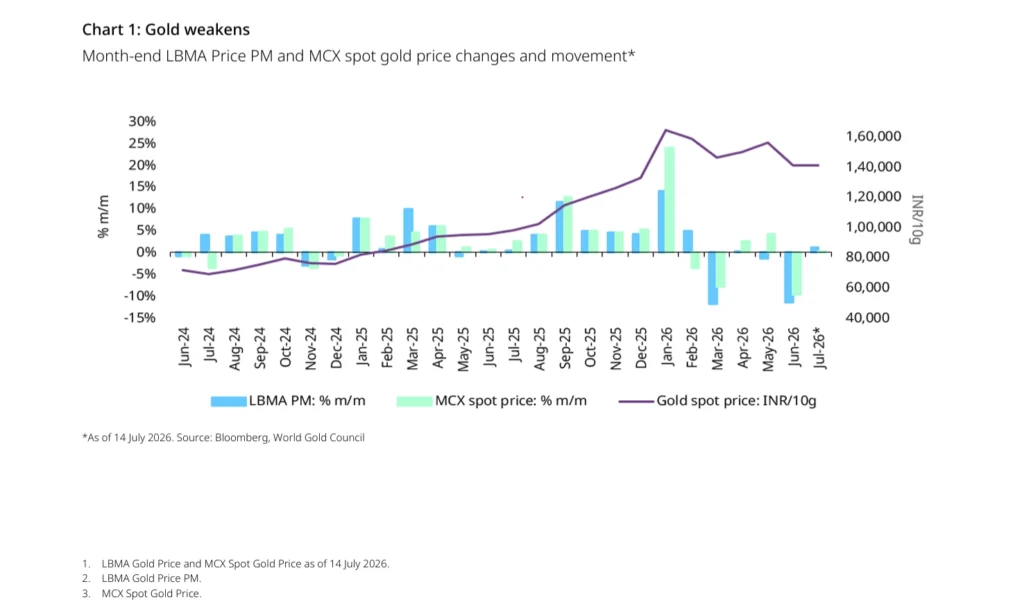
International and domestic gold prices recorded a sharp decline in June. The international price2 fell by more than 11% to around US$4,000/oz, its lowest level since October, while domestic price3 declined by around 10% to near INR141,000/10g, a six-month low. Although prices have recovered marginally since then, international gold price remains nearly 7% lower on a year-to-date basis. In contrast, domestic price is up around 6% y-t-d, supported by the 9% import duty hike in May and the INR depreciation against the US dollar.
A stronger US dollar, intensifying expectations of US rate hikes, and a rotation towards equities in Western markets have weighed on gold prices. At the same time, the pullback in prices has provided a buying opportunity to those waiting to enter the market, cushioning the decline in prices.
Ample supply keeps domestic prices at a discount
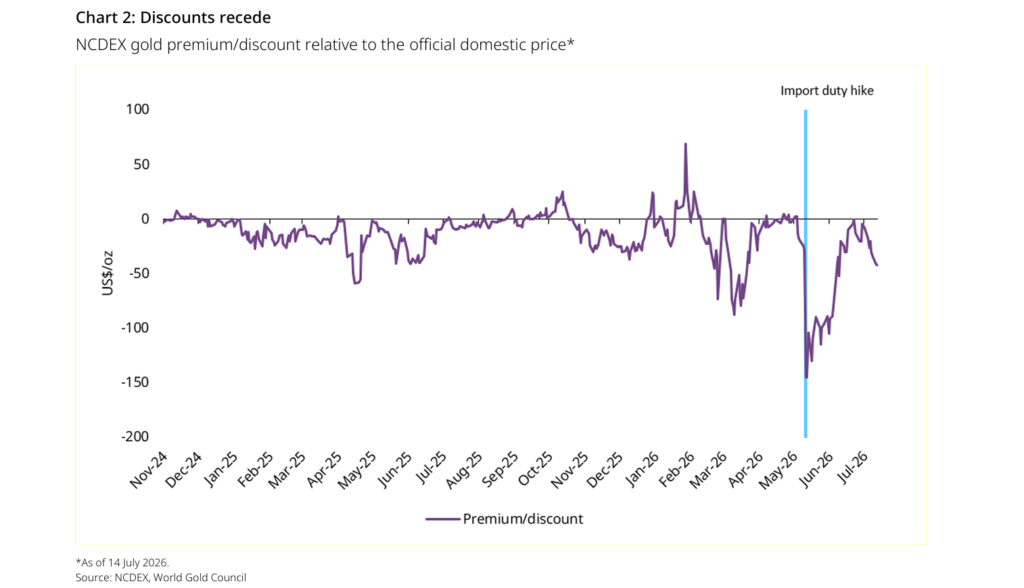
Gold price discounts in the domestic market have narrowed considerably from the elevated levels following the import duty hike in May and early June, indicating a gradual normalisation of market conditions. Discounts averaged around US$20/oz to the landed price4 during the first two weeks of July, significantly lower than the peak discount of nearly US$150/oz recorded in May. Domestic prices briefly traded close to parity with the landed price in late June and early July, indicating an improving market balance. Discounts have widened since to US$40/oz as of mid-July. The prevailing level of discount reflects the availability of ample domestic supply relative to demand. Industry interactions indicate that the rise in old gold exchange for new jewellery has increased the supply of gold in the market.
Jewellery buying gains traction
Following a month-long lull from mid-May to mid-June, driven by seasonally softer demand, an inauspicious period,5 policy measures and the Prime Minister’s appeal to limit gold purchases, consumer demand has reportedly begun to recover. Industry feedback suggests that while overall demand remains subdued, consumer buying has picked up in recent weeks, led primarily by jewellery. In contrast, bar and coin demand appears to have cooled.
The pullback in gold prices and the relative price stability are said to be stimulating jewellery purchases. The promotional campaign by retailers, including discounts, exchange offers, flexible payment terms, etc., have also been supporting sales. Notably, demand has not been limited to wedding-related purchases. Manufacturers too have been receiving order bookings from retailers in preparation for the festive season from August.
At the same time, softer prices have tempered demand for bars and coins, which are typically bought for investment purposes and tend to attract stronger interest during periods of rising prices.
Meanwhile, the exchange of old gold jewellery has gained further traction following the import duty hike in mid-May. Retailers report that exchange volumes have risen by a further 10–20%, with some indicating that old gold exchanges now account for as much as 70% of jewellery sales.
Healthy performance of listed jewellers in April–June quarter
Major listed jewellery retailers6 reported a strong April–June quarter despite an inauspicious period that typically tempers purchases. Revenue growth was broadly in the high 30–60% y/y range, supported by regional festivals, the summer wedding season and Akshay Tritiya7 during the early part of the quarter.
Demand was broad, with plain gold and studded jewellery registering double-digit sales growth. Retailers also reported growth both in customer additions and average ticket sizes.
Old gold exchange for new jewellery continued to rise on average accounting for somewhere between 43–55% of sales during the quarter, aided in part by promotional and marketing campaigns. These retailers continued with their store expansions, adding between 8 and 33 stores across the country during the quarter. The continued pace of store openings can be seen as reflecting industry confidence in the medium-term outlook for jewellery demand.
Price pullback drives ETF inflows
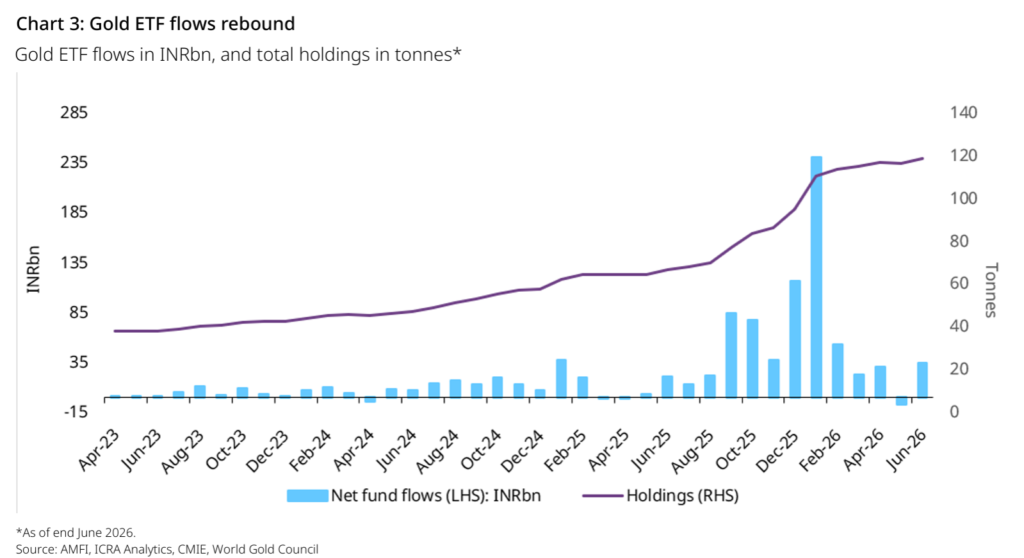
Indian gold ETFs recorded a rebound in June, in contrast to the global trend of outflows, as investors bought into the price dips. Net inflows during the month were INR34.4bn (US$356mn), the highest since February. Holdings increased by 2.2t to 119t, in line with our estimates, while the cumulative AUM fell 8% m/m, reflecting the decline in gold prices during the month.
The price pullback appears to have been viewed as a buying opportunity by investors, with inflows remaining healthy in early July. During 1–10 July, net inflows are estimated at INR12.1bn (US$127mn). Investor participation also broadened, with 135k new folios (accounts) being added during the month, taking the total number of accounts to 12.5mn.
Increased buying of digital gold
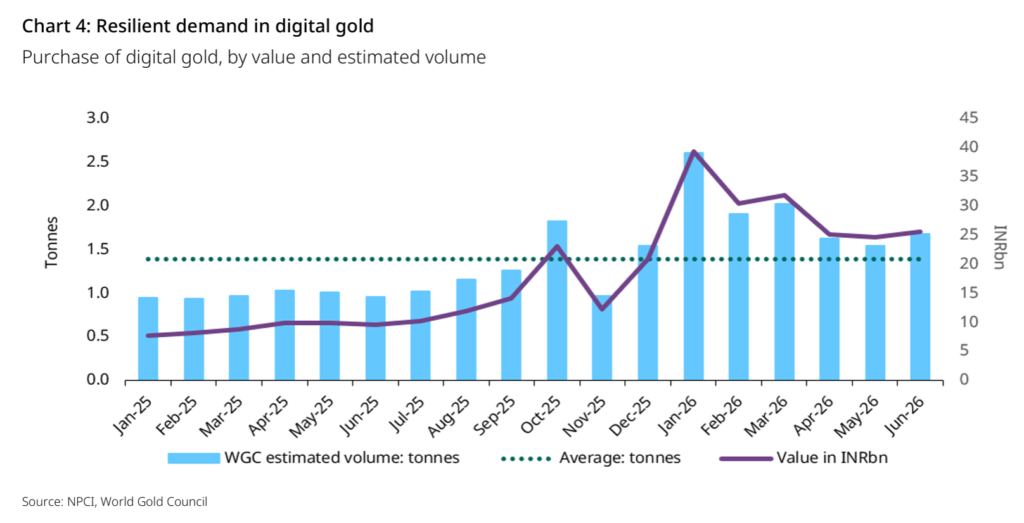
Digital gold purchases through the Unified Payment Interface (UPI) rebounded in June after moderation in the previous month. Both transaction value and estimated volumes reached a three-month high, pointing to renewed investor interest. Transaction value rose 4% m/m to INR25.5bn (US$269mn), while volumes are estimated to have increased 9% m/m to 1.7t. Purchases during the month were above the 17-month average of 1.4t and remained within the highertransacting category of UPI, suggesting that demand in the digital gold segment continues to be resilient.
Imports ease amid soft demand and recycled supply
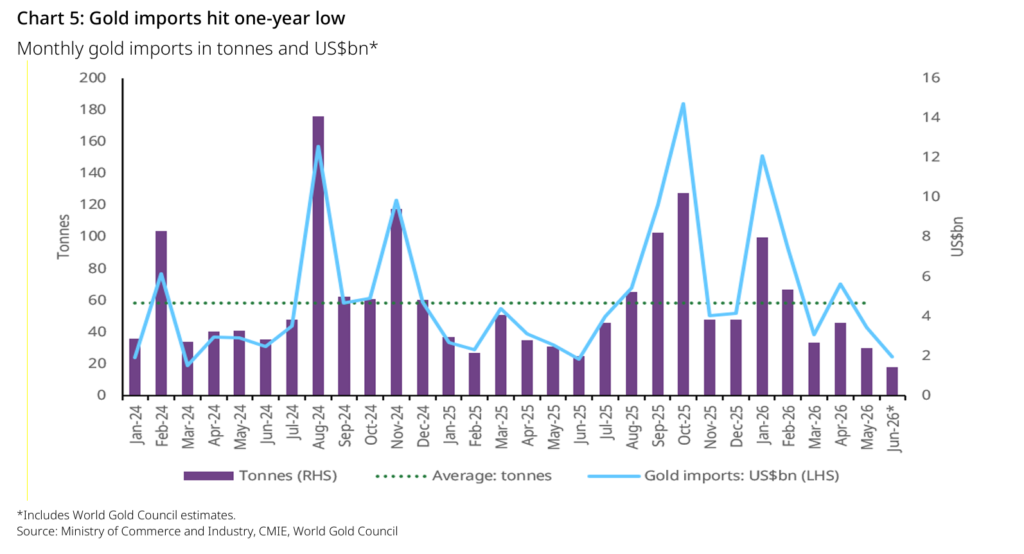
Gold imports weakened further in June, declining for a second consecutive month. At US$1.97bn, imports were down 42% m/m and the lowest since June 2025. However, import value was 7% higher y/y, driven largely by higher gold prices, with the average landed cost of gold rising 38% from a year ago.8 Import volumes in June are estimated at 16–22t, down from 29t in May and 25t in June 2025. The decline in import volumes is reflective of softer demand, elevated inventories in the supply chain, and supply from the exchange and sale of old gold. Old gold supply has risen since the import duty hike, lowering the need for fresh imports. Consequently, gold’s share of total merchandise imports fell to 3% in June, well below the 17% recorded in January.
FAQs
What caused gold prices to fall in June 2026?
Gold prices declined due to a stronger US dollar, expectations of higher US interest rates, and investors shifting towards equities.
Why did jewellery demand improve?
The sharp correction in gold prices encouraged consumers to resume jewellery purchases, supported by retailer discounts and exchange offers.
How did gold ETFs perform?
Indian gold ETFs recorded strong inflows in June as investors used the price correction as a buying opportunity.
What happened to digital gold demand?
Digital gold purchases increased, with transaction values and estimated volumes reaching a three-month high.
Why did gold imports decline?
Lower consumer demand, higher recycled gold supply, and sufficient domestic inventories reduced the need for fresh imports.
Source: SVAR Media Network
About SVAR Media Network – India’s Best Source for Jewellery News, Magazines, Newsletters and Media
SVAR Media Network is India’s No. 1 Destination for Jewellery News, setting the gold standard in timely, trusted, & trend-driven coverage across the Gems & Jewellery industry. As the Most Followed Jewellery Magazine & Media House in India, SVAR delivers Daily Jewellery News India Updates, market insights, & global developments through its platforms like Jewellery Magazine, Newsletters, AI Powered News Bulletins, Website, Social Media, Podcasts, & much more.
Recognized as Asia’s one of the Best Media in Jewellery & one of the World’s Best Jewellery Media, SVAR Media Network sets Unparalleled Standards in the Gems & Jewellery industry. SVAR is the Most Trusted & Widely Read Voice in the Gems & Jewellery Community.
Renowned as India’s Best Jewellery Magazine & Leading Jewellery Media, SVAR blends legacy with cutting-edge innovation by delivering:
- Best in class Jewellery Magazine for the Gems & Jewellery Industry & Jewellery Enthusiasts
- Real-time AI-Powered Jewellery News via SVARA AI, the World’s First AI Anchor in Fashion, Gems & Jewellery Industry
- India’s One of the First Gems & Jewellery Podcasts
- Digital Jewellery Newsletters for professionals and enthusiasts
- ISO 9001:2015 Certification, the first in the jewellery-media sector, proving our commitment to excellence
- Asia’s First & World’s Second Meta Verified Jewellery Media Brand

Ranked #1 among the Top 5 Gems & Jewellery News Websites, Top 10 Jewellery Magazines in India, & Most Influential Jewellery Media Brands, SVAR Media Network is your Trusted Source for Accurate, Fast, & Future-Focused Jewellery News.
SVAR Media Network is India’s No 1 Digital Media in Jewellery Industry & continues to be the Leading Jewellery Magazine & a Global Leader in Jewellery Media. SVAR Media Network offers a diverse range of services, including: Monthly Magazines, Digital Newsletters, Al-Driven News Bulletins, Social Media Promotions, Website Blogs & Articles, WhatsApp Updates, Podcasts & more…
Whether you seek updates on New Launches, Trade Shows, Celebrity Campaigns, Trends or Market Movements, SVAR is the Authority in Jewellery News India & beyond.
Explore the World of Gems & Jewellery with SVAR Media Network — Your Best Source for Trusted, Trend-Setting Jewellery News & Mediapp Updates, Podcasts & more…